40 years ago AUGUST 19, 1986: Agitation by Pak opposition
Opposition parties in Pakistan launched a countrywide indefinite agitation against the government crackdown on them and to overthrow President Zia-ul-Haq. The protests left at least eight people, including four policemen, dead.
Intelligence analysis by Llama
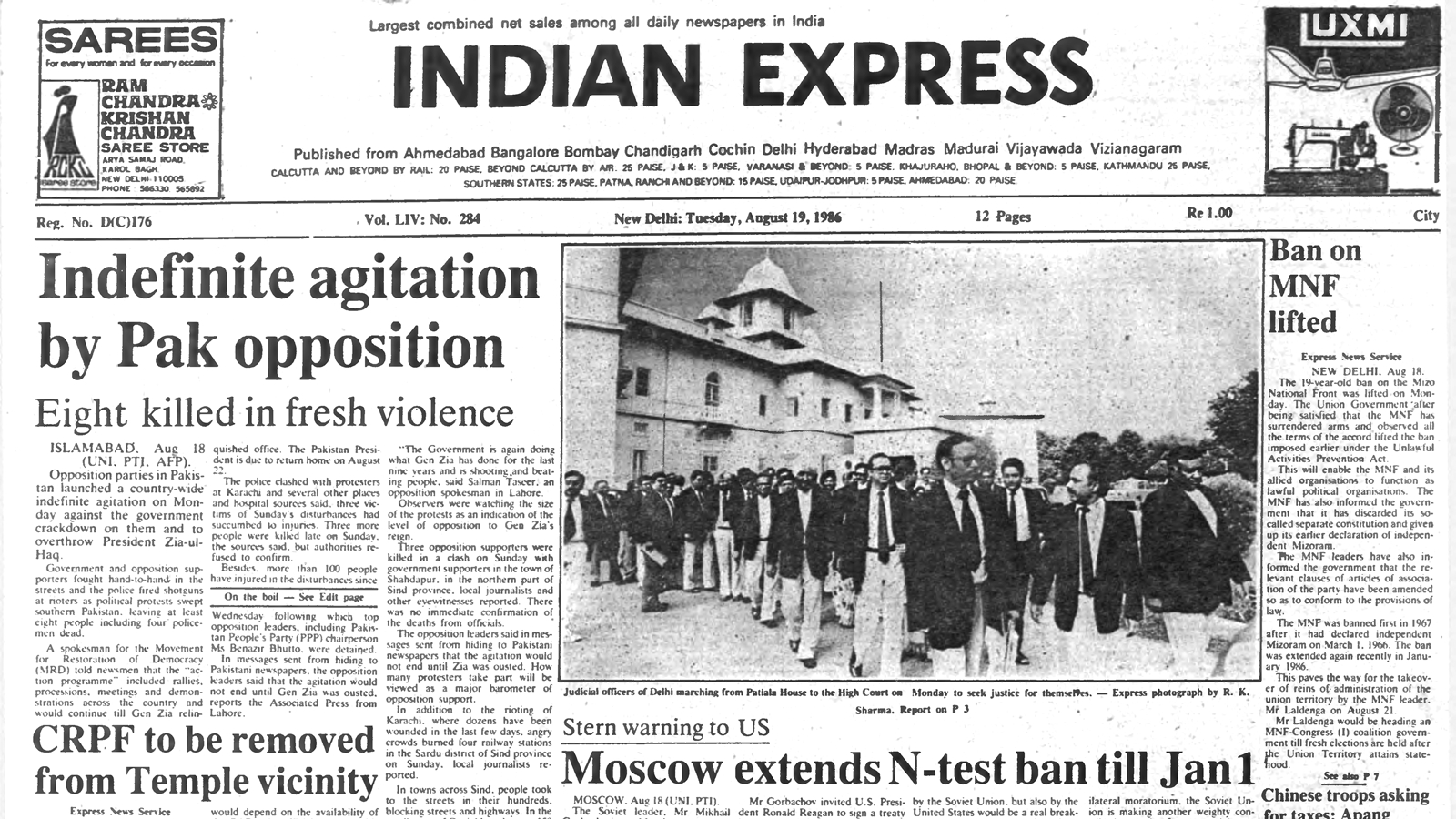
Forty years ago, opposition parties in Pakistan launched a countrywide agitation against the government, resulting in violent clashes and eight deaths. The protests were aimed at overthrowing President Zia-ul-Haq.
Imagine a big country called Pakistan where the government is in charge. But the people who don't agree with the government are very upset and want to make a change. They start a big protest, but the government gets angry and uses force to stop them. This makes a lot of people very sad and some even get hurt. It's a very complicated situation, but it shows how important it is for people to have a say in how their country is run.
Analysis
Agitation in Pakistan: A 40-Year-Old Story of Resistance and Repression
The Indian Express' front page from August 19, 1986, captures a pivotal moment in Pakistan's history. Opposition parties, frustrated with the government's crackdown on them, launched a countrywide agitation to overthrow President Zia-ul-Haq. The protests, marked by violent clashes between government supporters and opposition activists, resulted in the deaths of at least eight people, including four policemen.
The agitation was a culmination of years of growing discontent among opposition parties, who felt that the government was stifling their voices and limiting their freedoms. The protests, which swept across southern Pakistan, were a testament to the resilience and determination of the opposition, who were willing to risk their lives to bring about change.
The government's response to the agitation was brutal, with police firing shotguns at rioters and using force to disperse the crowds. The violence that ensued left a trail of destruction and death in its wake, a stark reminder of the high stakes involved in the struggle for power and influence in Pakistan.
The agitation also highlighted the complex and often fraught relationship between the government and the opposition in Pakistan. The government, led by President Zia-ul-Haq, was seen as increasingly authoritarian and repressive, with a penchant for using force to quell dissent and opposition.
The opposition, on the other hand, was seen as a force to be reckoned with, determined to bring about change and challenge the government's authority. The agitation, which was marked by intense passion and commitment, was a testament to the power of the opposition to shape the course of events in Pakistan.
In the end, the agitation failed to achieve its goal of overthrowing President Zia-ul-Haq, but it marked a significant turning point in Pakistan's history. It highlighted the need for greater accountability and transparency in government, and the importance of protecting the rights and freedoms of citizens.
Today, as Pakistan continues to grapple with the challenges of democracy and governance, the story of the 1986 agitation serves as a reminder of the importance of protecting the rights and freedoms of citizens, and the need for greater accountability and transparency in government.
Key points
- Opposition parties in Pakistan launched a countrywide indefinite agitation against the government crackdown on them and to overthrow President Zia-ul-Haq.
- The agitation resulted in violent clashes between government supporters and opposition activists, leaving at least eight people dead.
- The government's response to the agitation was brutal, with police firing shotguns at rioters and using force to disperse the crowds.
- The agitation highlighted the complex and often fraught relationship between the government and the opposition in Pakistan.
- The opposition was seen as a force to be reckoned with, determined to bring about change and challenge the government's authority.
If the opposition parties in Pakistan had been successful in their agitation, it could have led to a more democratic and accountable government. This could have resulted in greater freedoms and protections for citizens, and a more stable and peaceful society.
However, the government's brutal response to the agitation could have led to further repression and violence, making it even harder for the opposition to bring about change. This could have resulted in a more authoritarian and repressive government, with a greater disregard for human rights and freedoms.