40 years ago November 6, 1986: Democrats seize Senate
On November 6, 1986, Democrats regained control of the US Senate in midterm elections, while India's Lok Sabha saw an Opposition walkout and the Supreme Court issued a significant ruling on suing foreign states.
Intelligence analysis by Gemini 2.5 Flash
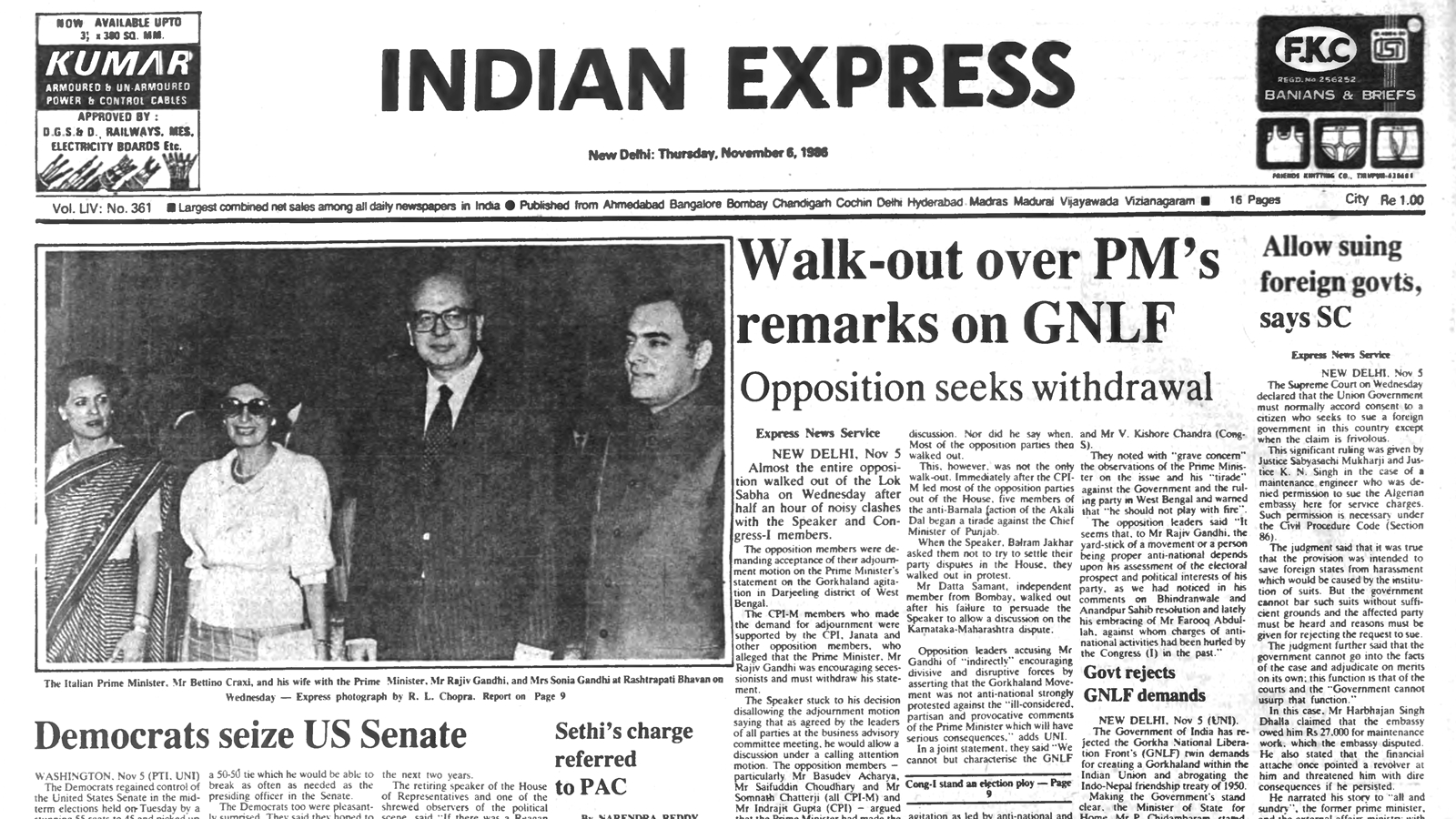
This article from '40 years ago' by The Indian Express recaps major news events reported on November 7, 1986, focusing on the US midterm elections where Democrats secured the Senate, a parliamentary walkout in India over the Gorkhaland agitation, and a US intelligence report suggesting Pakistan's potential nuclear weapon capability.
Imagine 40 years ago, big news was happening! In America, one political team, the Democrats, won lots of seats and took charge of a big meeting place called the Senate. In India, many politicians got upset and walked out of their main meeting, called the Lok Sabha, because they wanted to talk about a problem in a place called Gorkhaland. Also, there was a secret report saying Pakistan might be trying to build a powerful bomb, which made some people worried.
Analysis
The November 6, 1986, news cycle, as revisited by The Indian Express, presented a multifaceted global and domestic political landscape. The most prominent international headline was the Democratic Party's decisive victory in the United States midterm elections, which saw them reclaim control of the Senate. This shift from Republican dominance marked a significant change in the legislative balance of power, potentially impacting President Ronald Reagan's remaining term and policy agenda. The Democrats secured a commanding 55-45 majority in the Senate and further solidified their existing control in the House of Representatives, indicating a strong public mandate against the incumbent administration's party.
United States Senate
The midterm elections delivered a substantial blow to the Republican Party, particularly in the Senate, where they lost several key races. The Democrats' success was attributed to various factors, including voter dissatisfaction with certain aspects of the Reagan administration's policies and effective campaigning on local issues. This electoral outcome meant that the Democratic Party would now have greater leverage in legislative processes, potentially leading to increased scrutiny of presidential initiatives and a more challenging environment for passing Republican-backed legislation. The shift in control was a clear indicator of the American electorate's evolving political preferences and its willingness to divide power between the executive and legislative branches.
Lok Sabha Walkout
Domestically, India faced its own political turbulence, as almost the entire Opposition staged a walkout from the Lok Sabha. This dramatic protest was triggered by clashes with the Speaker and members of the ruling Congress(I) party, stemming from the Opposition's demand for the acceptance of an adjournment motion. The motion sought to discuss the Prime Minister's statement regarding the Gorkhaland agitation, a significant regional issue concerning the demand for a separate state by the Gorkhas in West Bengal. The walkout underscored deep divisions within the Indian Parliament and highlighted the intensity of political discourse surrounding regional autonomy and government accountability during that period.
Pakistan's Nuclear Ambitions
Adding a layer of geopolitical tension, a report in the US press, specifically by Bob Woodward in The Washington Post, claimed that US intelligence indicated Pakistan had detonated a high-explosive device. The White House, however, dismissed this report as 'speculative.' Woodward's disclosures suggested that Pakistan could be on the verge of developing a small nuclear weapon in the 'not-so-distant future.' This revelation, despite official denials, raised significant concerns about nuclear proliferation in South Asia and the potential for regional instability. It highlighted the ongoing international scrutiny of Pakistan's nuclear program and its implications for global security, a topic that would continue to be a point of contention for years to come.
Key points
- Democrats regained control of the United States Senate in the 1986 midterm elections, securing a 55-45 majority.
- The Opposition in India's Lok Sabha staged a walkout following clashes over an adjournment motion concerning the Gorkhaland agitation.
- India's Supreme Court ruled that the Union government must generally permit citizens to sue foreign governments in the country, unless the claim is frivolous.
- A report by Bob Woodward in The Washington Post, citing US intelligence, suggested Pakistan had detonated a high-explosive device and could soon possess a small nuclear weapon, though the White House dismissed it as 'speculative'.