Amy Sherald on 'Ecclesia,' her most ambitious work yet
American realist portraitist Amy Sherald discusses her most ambitious work yet, a triptych called 'Ecclesia,' featuring three massive paintings with curved canvases on top, each featuring a Black person in brightly-colored clothing gazing out from a watchtower.
Intelligence analysis by Llama
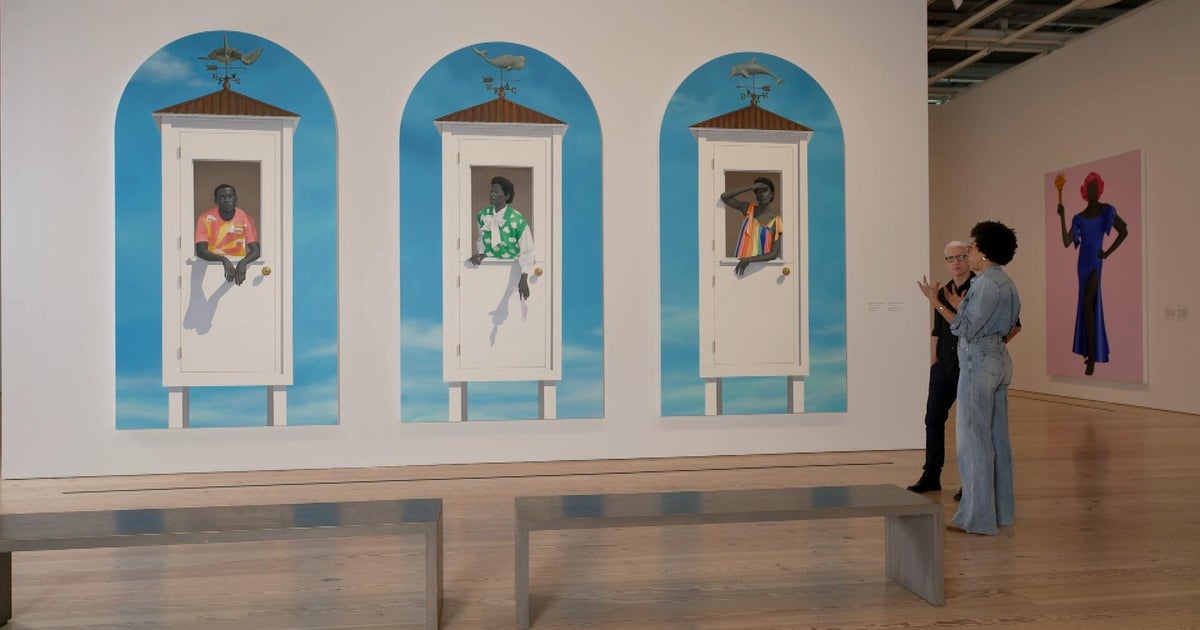
Amy Sherald's 'Ecclesia' is a triptych of three massive paintings, each featuring a Black person in brightly-colored clothing gazing out from a watchtower. Sherald discusses the inspiration behind the work, including a trip to the Uffizi Galleries in Florence, Italy, and the work of filmmaker Wes Anderson.
Amy Sherald is a famous artist who made a big painting called 'Ecclesia.' It's a triptych, which means it's three paintings stuck together. The paintings are very big and have curved canvases on top. They feature Black people in brightly-colored clothing looking out from watchtowers. Sherald was inspired by a trip to Italy and a movie called 'The Grand Budapest Hotel.' She had to use big brushes to paint the big canvases, and it took her half a year to finish the three paintings.
Analysis
A $60B Vote of Confidence
Amy Sherald's 'Ecclesia' is a triptych of three massive paintings, each featuring a Black person in brightly-colored clothing gazing out from a watchtower. The watchtowers appear to float in a bright blue sky, with no clues for the viewer as to where they are or what they are facing on the horizon. Sherald's use of curved canvases and brightly-colored clothing creates a sense of depth and dimensionality, drawing the viewer's eye to the figures in the paintings.
Sherald's inspiration for 'Ecclesia' came from a trip to the Uffizi Galleries in Florence, Italy, where she saw some of the most well-known examples of triptychs in art history. She was also inspired by the work of filmmaker Wes Anderson, specifically his movie 'The Grand Budapest Hotel.' The stand in the painting was inspired by the film, and Sherald has said that she was drawn to the idea of a random telephone booth in the middle of a snowy field.
The paintings in 'Ecclesia' are massive in size, and Sherald required scaffolding to reach every corner of the canvas. It took her some time to adjust to working on a larger canvas, and she had to paint with bigger brushes, which was different for her. The three paintings that form 'Ecclesia' took half a year to complete, and Sherald has said that they are the exclamation point of her exhibition at the Whitney Museum.
Sherald's retrospective show at the Whitney was 'emptying the Rolodex [of everything] in my mind for probably 20 years,' and she was 'starting over' at 52 years old. She has said that she is excited and terrified about the future, but knows that she is 'gonna be OK' because she knows who she is and that she doesn't make ugly paintings.
Why Cursor?
Sherald's use of curved canvases and brightly-colored clothing in 'Ecclesia' creates a sense of depth and dimensionality, drawing the viewer's eye to the figures in the paintings. The watchtowers appear to float in a bright blue sky, with no clues for the viewer as to where they are or what they are facing on the horizon. This creates a sense of mystery and intrigue, encouraging the viewer to look closer and try to understand what is happening in the painting.
The Road Ahead
Sherald's 'Ecclesia' is a significant work in her career, showcasing her growth as an artist and her ability to create complex and thought-provoking pieces. The use of curved canvases and brightly-colored clothing creates a sense of depth and dimensionality, drawing the viewer's eye to the figures in the paintings. Sherald's inspiration for 'Ecclesia' came from a trip to the Uffizi Galleries in Florence, Italy, and the work of filmmaker Wes Anderson. The paintings in 'Ecclesia' are massive in size, and Sherald required scaffolding to reach every corner of the canvas. It took her some time to adjust to working on a larger canvas, and she had to paint with bigger brushes, which was different for her.
Key points
- Amy Sherald's 'Ecclesia' is a triptych of three massive paintings, each featuring a Black person in brightly-colored clothing gazing out from a watchtower.
- The watchtowers appear to float in a bright blue sky, with no clues for the viewer as to where they are or what they are facing on the horizon.
- Sherald's use of curved canvases and brightly-colored clothing creates a sense of depth and dimensionality, drawing the viewer's eye to the figures in the paintings.
- The paintings in 'Ecclesia' are massive in size, and Sherald required scaffolding to reach every corner of the canvas.
- It took Sherald some time to adjust to working on a larger canvas, and she had to paint with bigger brushes, which was different for her.
Amy Sherald's 'Ecclesia' is a significant work in her career, showcasing her growth as an artist and her ability to create complex and thought-provoking pieces. The use of curved canvases and brightly-colored clothing creates a sense of depth and dimensionality, drawing the viewer's eye to the figures in the paintings. Sherald's inspiration for 'Ecclesia' came from a trip to the Uffizi Galleries in Florence, Italy, and the work of filmmaker Wes Anderson. The paintings in 'Ecclesia' are massive in size, and Sherald required scaffolding to reach every corner of the canvas. It took her some time to adjust to working on a larger canvas, and she had to paint with bigger brushes, which was different for her.
Amy Sherald's 'Ecclesia' may be a significant work in her career, but it also raises questions about the future of art and the role of the artist. The use of curved canvases and brightly-colored clothing creates a sense of depth and dimensionality, but it also creates a sense of uncertainty and ambiguity. Sherald's inspiration for 'Ecclesia' came from a trip to the Uffizi Galleries in Florence, Italy, and the work of filmmaker Wes Anderson, but it also raises questions about the influence of external factors on artistic creation.