Azerbaijan engineers rare summit with in-conflict Middle East and Asian leaders
Azerbaijan hosted a rare "confidence-building measures" summit (CICA) in Baku, bringing together top delegations from Middle Eastern and Asian countries, including Israel and Iran, amidst ongoing conflicts.
Intelligence analysis by Gemini 2.5 Flash
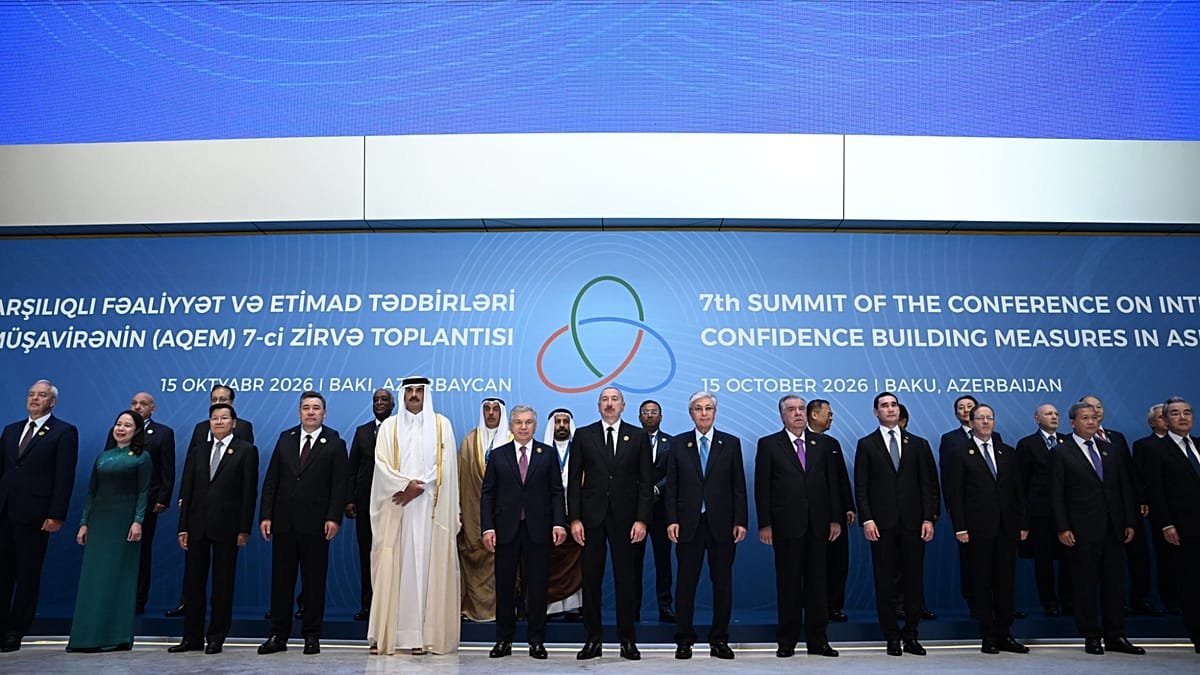
The seventh CICA summit in Baku saw leaders from nations in conflict, notably Israel and Iran, engage in dialogue focused on regional security, transport, digital cooperation, and sustainable growth. Azerbaijan's President Ilham Aliyev spearheaded the initiative, emphasizing his country's strategic role in fostering stability and cooperation across Eurasia.
Imagine a big meeting where kids who usually argue a lot are asked to sit down and talk about how to get along better. That's what Azerbaijan did, bringing leaders from countries that are often fighting, like Israel and Iran, to talk about peace and working together. Azerbaijan wants to be like a friendly bridge between different parts of the world, helping everyone get along.
Analysis
Azerbaijan has successfully positioned itself as a crucial diplomatic nexus, hosting the Conference on Interaction and Confidence-Building Measures in Asia (CICA) in Baku. This event was particularly notable for bringing together high-level delegations from countries currently embroiled in political and military conflicts, including Israel and Iran, for the first time since the outbreak of the Iran war. The summit's agenda focused on critical areas such as regional security, transport links, digital cooperation, and sustainable growth, underscoring a broad effort to foster stability and mutual trust across the Eurasian continent.
CICA
The Conference on Interaction and Confidence-Building Measures in Asia (CICA) is explicitly defined as a forum dedicated to promoting peace, security, and cooperation through dialogue and mutual trust. Its seventh edition, hosted by Azerbaijan, served as a platform for strengthening cooperation across Asia, particularly in tumultuous times. The gathering saw participation from heads of state and government from various Asian nations, including Uzbekistan, Kazakhstan, Kyrgyzstan, Tajikistan, China, Laos, Cambodia, Vietnam, India, and Sri Lanka, alongside the Middle Eastern delegations. This diverse attendance highlights the forum's broad reach and its potential to address complex regional challenges through multilateral engagement.
Ilham Aliyev
Azerbaijan's President Ilham Aliyev played a pivotal role in orchestrating this rare diplomatic gathering, asserting his country's increasing importance as a "connecting hub in the Eurasian space." In his opening address, Aliyev emphasized Azerbaijan's geographical advantage at the intersection of Asia and Europe, leveraging its bilateral and multilateral cooperation in political, economic, transport, energy, and humanitarian fields to strengthen regional security. His leadership in bringing together such a disparate group of leaders, including those from actively conflicting nations, underscores Azerbaijan's ambition to be a significant mediator and a force for stability in a volatile geopolitical landscape.
Isaac Herzog
Israel's President Isaac Herzog's participation was a key highlight, marking a significant diplomatic move. Herzog traveled to Baku, meeting with President Aliyev, whom he described as a "friend" and an "important partner of Israel in our region." His visit aimed to strengthen Israel-Azerbaijan ties in security, energy, and trade, and he also connected with the local Jewish community. Furthermore, Herzog held an "excellent meeting" with Bahrain's Foreign Minister Dr. Abdul Latif bin Rashid Al Zayani, discussing the importance of the Abraham Accords in enhancing security and prosperity in the Middle East. This interaction is particularly noteworthy given Bahrain's strained relations with Iran and recent bombings, signaling a continued effort to build alliances and foster regional stability amidst ongoing tensions.
Key points
- Azerbaijan hosted the seventh Conference on Interaction and Confidence-Building Measures in Asia (CICA) in Baku.
- The summit brought together top delegations from Middle Eastern and Asian countries, including Israel and Iran, amidst ongoing conflicts.
- Azerbaijan's President Ilham Aliyev positioned the country as a crucial "connecting hub in the Eurasian space" for peace and cooperation.
- Israel's President Isaac Herzog met with President Aliyev and Bahrain's Foreign Minister, emphasizing strengthening ties and the Abraham Accords.
- The agenda focused on regional security, transport links, digital cooperation, and sustainable growth.
The mere act of bringing together leaders from nations in active conflict, such as Israel and Iran, for dialogue offers a glimmer of hope for de-escalation and future diplomatic resolutions. Azerbaijan's role as a neutral host could foster trust, potentially leading to improved regional security and cooperation on shared challenges like transport and economic growth.
Despite the summit's intentions, the deep-seated conflicts and ongoing "Iran war" suggest that a single conference may have limited immediate impact on long-term peace. The presence of high-level delegations does not guarantee substantive breakthroughs, and underlying tensions could easily resurface, making sustained confidence-building a significant challenge.