Bitcoin drops to $81,400 as Asian chip stocks tumble, options traders seek downside protection
Bitcoin dipped to $81,400, down 0.5%, despite significant U.S. spot ETF inflows, as Asian chip stocks tumbled due to AI spending worries. Options traders are increasingly seeking downside protection, indicating a bearish sentiment.
Intelligence analysis by Gemini 2.5 Flash
Bitcoin experienced a slight decline to $81,400, influenced by a sharp fall in South Korea's Kospi index and major chipmakers like SK Hynix and Samsung Electronics, driven by renewed concerns over AI spending. This market movement occurred even as U.S. spot bitcoin ETFs recorded their largest daily inflow in nearly a month, highlighting a divergence in market signals, with derivatives…
Imagine Bitcoin is like a popular toy, and its price went down a little bit today. This happened even though lots of people bought a special kind of Bitcoin fund, like a big box of toys. The main reason for the dip was that big tech companies in Asia, especially those making computer chips for things like AI, saw their stock prices fall because people worried about how much money would be spent on AI. So, even though some people were buying Bitcoin, others were worried about the bigger picture, making them want to protect their money in case prices dropped more.
Analysis
The recent dip in Bitcoin's price to $81,400, a modest 0.5% decline, comes amidst a complex interplay of market forces. While U.S. spot bitcoin ETFs recorded their most substantial daily inflow in almost a month, attracting $526.6 million, the cryptocurrency market appears to be taking cues from traditional equity markets, particularly in Asia. The significant fall of South Korea's Kospi index by 3.73%, reaching its lowest close since April 7, underscores a broader market anxiety. This decline was primarily attributed to renewed worries surrounding AI spending, which heavily impacted major chipmakers such as SK Hynix and Samsung Electronics. The interconnectedness between traditional tech stocks and the crypto market is becoming increasingly apparent, with sentiment in one often spilling over into the other, suggesting that macro factors continue to exert considerable influence on digital asset valuations.
Kospi Index
The performance of the Kospi index serves as a critical indicator of the broader economic sentiment impacting technology-driven assets. Its sharp decline, coupled with the underperformance of key semiconductor manufacturers, reflects investor apprehension regarding the sustainability and growth trajectory of AI-related expenditures. This concern is not isolated to South Korea, as Nasdaq 100 futures also registered a slight dip, indicating a more widespread cautious outlook among investors globally. The article notes that altcoin losses were generally in line with Bitcoin's movement, with Ether falling 0.9% and the CoinDesk 80 index losing 0.34%. This synchronized downturn across various digital assets suggests that the underlying drivers are systemic rather than specific to individual cryptocurrencies, reinforcing the idea that the crypto market is maturing and becoming more correlated with traditional financial markets.
Deribit Data
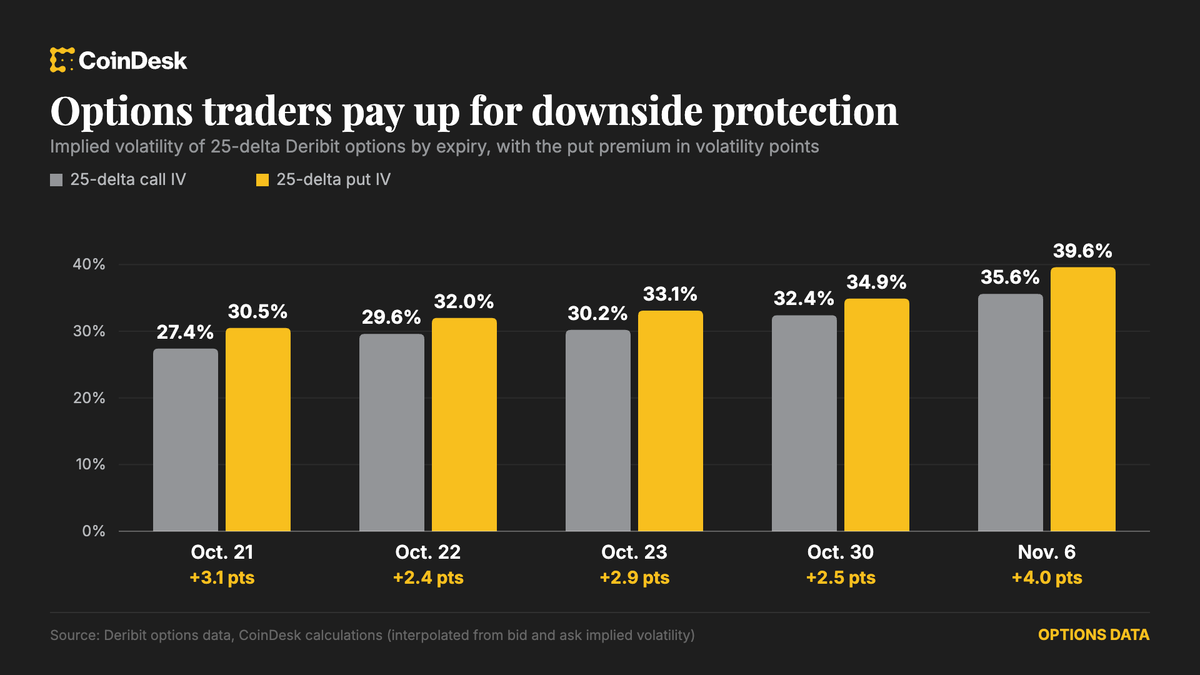
Derivatives markets are providing clear signals of a bearish tilt among traders. Data from Deribit shows that puts outtraded calls by more than two to one over a 24-hour period, with the Oct. 30 $80,000 put being the most active contract. This preference for puts, which are options contracts giving the holder the right to sell an asset at a specified price, indicates that traders are actively seeking downside protection against potential price drops. Furthermore, out-of-the-money puts were more expensive than equivalent calls across various expiries, by 2.5 to 4 volatility points, a phenomenon known as a bearish skew. This pricing dynamic explicitly demonstrates that market participants are willing to pay a premium for insurance against further declines, even as open interest data suggests some long positions are concentrated at higher price targets like $90,000-$100,000 for Oct. 30. The aggregated funding rate for Bitcoin, at roughly 8.8% annualized, also points to a slight bullish bias among perpetual futures traders, creating a mixed picture between spot and derivatives sentiment.
Celestia and Sandbox
Amidst the broader market downturn, some altcoins exhibited notable performance, albeit with mixed results. Celestia (TIA) emerged as the biggest gainer on the CoinDesk 100 Index, rising 2.2% and extending its monthly gain to about 42%. This surge coincided with Celestia's Fibre scaling system averaging 3.07 terabits per second and the selection of Celestia by options exchange Derive for data availability in its V3 release. This highlights the importance of fundamental developments and adoption in driving token value, even in a challenging market. Conversely, Sandbox (SAND) led the CD100 lower with a 4.5% drop, giving back some of its 30% monthly gain, which had been spurred by South Korean crypto exchanges lifting trading cautions. Layer-2 tokens like Arbitrum (ARB) and Starknet (STRK) also saw declines, though Starknet remains up significantly over the month following news of its consideration to become a standalone quantum-resistant layer-1 by 2027. DeFi tokens, including Uniswap (UNI) and Morpho (MORPHO), also handed back gains, with UNI slumping 20% over the month despite a strong September for protocol revenue, indicating that even positive internal metrics can be overshadowed by broader market sentiment.
Key points
- Bitcoin's price slipped to $81,400, a 0.5% decrease, despite U.S. spot bitcoin ETFs recording their largest daily inflow in nearly a month ($526.6 million).
- South Korea's Kospi index fell 3.73% to its lowest close since April 7, driven by renewed AI spending worries impacting chipmakers like SK Hynix and Samsung Electronics.
- Options traders on Deribit showed a bearish skew, with puts outtrading calls by more than two to one, indicating a strong demand for downside protection.
- Altcoins generally followed Bitcoin's trend, though Celestia (TIA) was a top gainer, rising 2.2% and 42% over the month due to scaling system performance and adoption.
- Brent crude oil is near $110 a barrel, with Houthi attacks on Saudi Arabia keeping supply risks in view.
Despite the overall market dip, U.S. spot bitcoin ETFs saw their largest daily inflow in nearly a month, indicating sustained institutional interest and potential underlying demand. Furthermore, specific altcoins like Celestia and Starknet demonstrated significant monthly gains driven by fundamental developments, suggesting pockets of strong performance and innovation within the broader crypto market.
The market faces headwinds from renewed AI spending worries impacting chipmakers, which contributed to the broader Asian stock tumble and could signal a cautious outlook for tech-related assets. Options traders are actively seeking downside protection, reflecting a bearish sentiment and potential for further price declines in the near term if macro concerns persist.