Bitcoin slips near $63,500 as traders look past CPI to Fed’s next tests
Bitcoin dipped to around $63,500 after an expected U.S. inflation report failed to ignite a crypto rally, with most major tokens declining despite eased nerves.
Intelligence analysis by Gemini 2.5 Flash
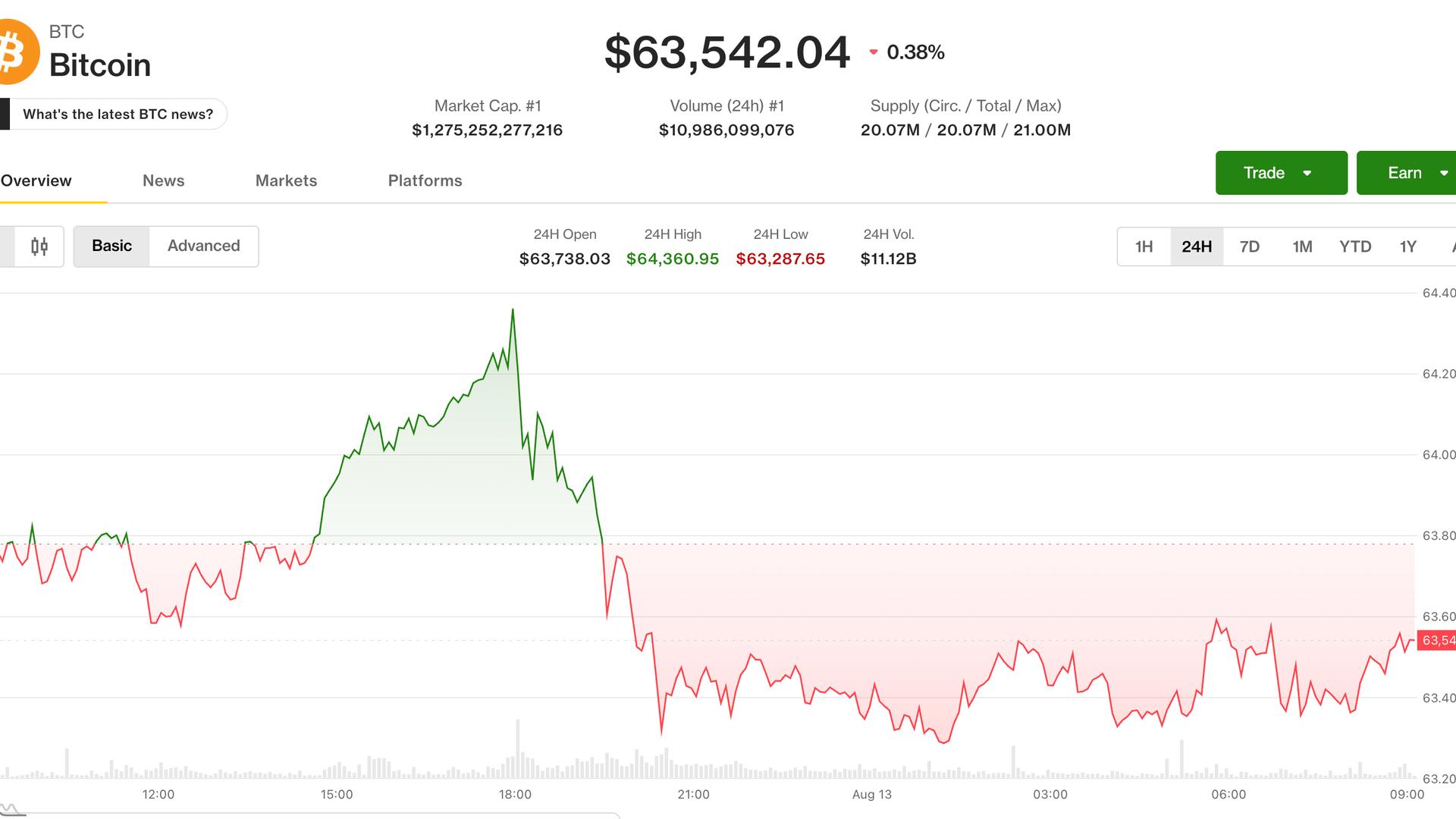
Traders largely overlooked an in-line July inflation report, which removed a 'tail risk' but didn't provide a strong catalyst for Bitcoin or the broader crypto market. Attention is now shifting to upcoming economic events like the Jackson Hole symposium, the September jobs report, and the next CPI release for potential market direction.
Imagine the grown-ups who decide how much money things cost were checking their report card (the inflation report). Everyone thought they'd get a 'B,' and they did! So, some things like gold and regular company stocks felt a little better, but Bitcoin, which is like a special digital money, didn't get super excited. It just stayed pretty much where it was, because there wasn't a big surprise. Now, everyone is waiting for the next big tests, like a meeting of important money people and more report cards, to see what happens next.
Analysis
An in-line U.S. inflation report for July, while easing some market anxieties, did not provide the necessary impetus for a significant rally in Bitcoin or the broader cryptocurrency market. Bitcoin slipped to approximately $63,500, reflecting a broader decline across most major tokens, including Dogecoin, XRP, BNB, Solana, and Ether. This reaction underscores a market that is increasingly sophisticated in its interpretation of economic data, often pricing in expected outcomes before official releases.
July Inflation
July's inflation figures aligned closely with economists' forecasts, showing a 0.1% monthly rise in headline inflation and a 3.4% annual increase. The core inflation measure, excluding volatile food and energy prices, rose 0.2% monthly and eased to 2.5% annually. This outcome was sufficient to reduce the perceived likelihood of a Federal Reserve rate hike in September, with futures markets adjusting probabilities from 46% to about 38%.
However, this expected outcome meant that the 'tail risk' of an unexpected surge in inflation was removed, but no new catalyst for upward price movement was introduced. While gold saw a modest 1.3% gain and S&P 500 futures rose 0.2% immediately after the report, Bitcoin's initial half-percent gain quickly dissipated, indicating a lack of conviction among crypto traders.
Gabe Selby
Gabe Selby, head of research at CF Benchmarks, provided insight into Bitcoin's typical reaction to inflation data. He noted that Bitcoin tends to move most significantly when inflation data forces a re-evaluation of interest rate expectations, particularly when there's a downside surprise. Historically, Bitcoin has gained an average of 3.25% on the three occasions in the past nine releases when inflation came in below expectations, with one such surprise on July 14 leading to a 4.24% rally.
Selby's analysis suggests that an in-line report, while positive for removing uncertainty, is not enough to generate a strong upward catalyst. He also pointed to factors like a modest 0.1% rise in shelter costs, a 1.5% drop in energy, and a 2.9% decline in gasoline prices as reasons for the Federal Reserve to potentially maintain its current stance, further reinforcing the 'wait and see' approach by the market.
Jackson Hole
With the July inflation report now in the rearview mirror, market participants are already looking ahead to the next series of significant economic events that could influence Federal Reserve policy and, consequently, crypto market sentiment. The upcoming Jackson Hole gathering of central bankers later this month is a key focus, as it often provides clues about future monetary policy directions from global financial leaders.
Following Jackson Hole, the September 4 jobs report will offer critical insights into the labor market's health, a major consideration for the Fed's dual mandate. Finally, the September 11 inflation release will provide the next official update on price pressures, which could either confirm the current trajectory or introduce a 'genuine surprise' that Selby suggests is needed to truly move the Bitcoin market. These events represent the next 'tests' for a market seeking clear direction.
Key points
- Bitcoin slipped to approximately $63,500 after an in-line U.S. inflation report for July.
- The July inflation data matched forecasts, easing nerves but failing to spark a broad crypto rally.
- Most major cryptocurrencies, including Dogecoin, XRP, and BNB, saw declines on the day.
- Global stock markets reacted more positively than crypto, with Asian indices advancing sharply.
- Traders are now looking to the Jackson Hole gathering, the September jobs report, and the next CPI release as future market catalysts.
The in-line inflation report reduces the immediate pressure on the Federal Reserve for aggressive rate hikes, potentially creating a more stable economic environment. This stability could eventually foster a more favorable backdrop for risk assets like cryptocurrencies, as the Fed might opt to wait on further rate moves.
Despite the inflation report easing some nerves, Bitcoin's inability to rally and the decline of most major tokens suggest a lack of strong bullish catalysts. The market remains highly dependent on future economic data and Federal Reserve actions, with upcoming events like Jackson Hole and new jobs/inflation reports posing potential volatility risks.
Market signals
- BTC Bitcoin slipped near $63,500, down over half a percent on the day, as the in-line inflation report failed to provide a rally catalyst.
- XAU Gold rose 1.3% in the immediate aftermath of the inflation report, indicating a modest positive reaction.
- OIL Brent crude snapped a six-day run of gains, easing after the inflation report and geopolitical comments.
AI-generated analysis of potential market relevance. Not financial advice.