Carney says EU and Canada are ‘stronger together’ as Trump threatens EU over proposal to make Canada first associate member – Europe live
Canadian PM Mark Carney called for closer EU-Canada ties, including potential associate membership, to build strategic autonomy amid global instability and US threats.
Intelligence analysis by Gemini 2.5 Flash
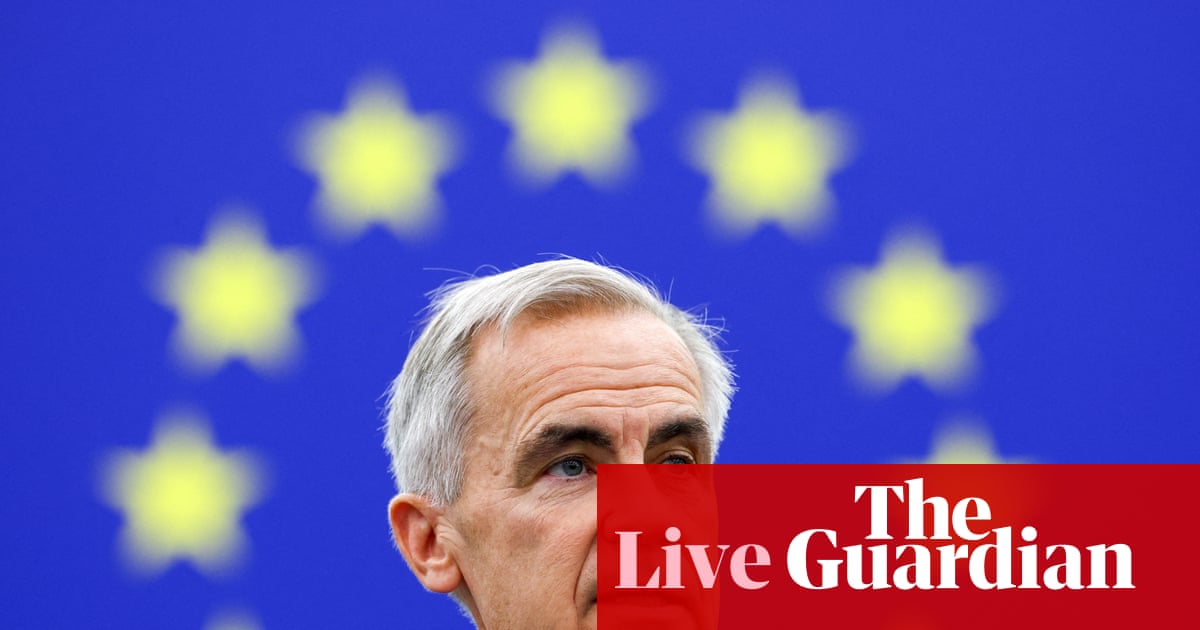
Canadian Prime Minister Mark Carney addressed the European Parliament, advocating for a deeper partnership with the EU, emphasizing strategic autonomy, trade, and mobility. His vision for a 'transatlantic forest' of shared values comes as former US President Donald Trump reportedly threatens the EU over the prospect of Canada becoming an associate member.
Imagine Europe and Canada are like two friendly neighbors who want to build a super strong treehouse together. The Canadian leader, Mark Carney, visited Europe and said, "Let's make our treehouse even stronger so no big bullies can push us around!" He wants them to share toys (like important materials and smart ideas) and let their kids visit each other easily. But a big bully, Donald Trump, is grumbling and threatening to cause trouble if they get too close.
Analysis
Mark Carney
Canadian Prime Minister Mark Carney delivered a significant address to the European Parliament, advocating for a deeper and more resilient partnership between Canada and the European Union. His speech emphasized the need for "strategic autonomy" and robust cooperation across various sectors, positioning this alliance as a bulwark against global instability. Carney's vision extends beyond mere economic ties, aiming to foster a shared "transatlantic forest" of values and free people.
Carney explicitly stated that this proposed alliance is not intended to form a "third bloc" to rival existing great powers. Instead, he framed it as a union of "resilient nations" committed to reinforcing international law rather than seeking to replace it. This nuanced approach highlights a desire for collective strength and stability in a world increasingly characterized by geopolitical competition and the weaponization of trade and technology.
Associate Membership
A key development highlighted in the address was the welcoming of a suggestion for Canada to become an "associate member" of the EU. This concept, also floated by European Parliament President Roberta Metsola, could open doors for closer relations with other like-minded countries. Such a status would signify a profound deepening of ties, moving beyond traditional trade agreements to a more integrated partnership.
The potential for associate membership underscores a mutual recognition of shared interests and values between Canada and the EU. It suggests a pathway for non-member states to align more closely with the EU's strategic objectives and participate in its frameworks, such as the Erasmus+ student exchange and Horizon research schemes. This initiative could serve as a model for future collaborations, enhancing the EU's global reach and influence.
Strategic Autonomy
Carney detailed specific areas for cooperation aimed at securing strategic autonomy for both Canada and Europe. These include deep collaboration in critical capabilities such as critical minerals, defense, industrial capacity, artificial intelligence, compute power, energy security, space, and payments. The goal is to reduce reliance on assertive superpowers and build independent resilience in crucial sectors.
Furthermore, Carney advocated for seamless digital trade and non-agricultural goods and services, alongside deeper people-to-people ties, including student and worker mobility. This comprehensive approach to strategic autonomy seeks to create a robust, interconnected framework that can withstand external shocks and challenges, ensuring the prosperity and security of both Canadian and European citizens in an unpredictable global environment.
Key points
- Canadian PM Mark Carney called for closer strategic ties and 'associate membership' between Canada and the EU.
- The proposed alliance aims to build 'strategic autonomy' in critical areas like defense, AI, energy, and critical minerals.
- Carney emphasized that the partnership is not meant to form a 'third bloc' but to reinforce international law.
- The initiative comes amidst global instability and reported threats from Donald Trump regarding the EU's offer to Canada.
- Cooperation would extend to seamless digital trade, non-agricultural goods, and enhanced student and people mobility.
Closer ties between Canada and the EU, potentially through associate membership, could create a powerful democratic alliance capable of navigating global challenges and fostering economic stability. This partnership could enhance strategic autonomy in critical sectors, promote shared values, and offer a model for international cooperation in an increasingly fragmented world. Increased student and worker mobility would also enrich cultural exchange and innovation.
The proposed deepening of EU-Canada relations faces significant headwinds, particularly from former US President Donald Trump's threats of tariffs and protectionist policies. Such external pressure could complicate the implementation of new agreements and potentially strain transatlantic relationships. Global instability, including ongoing conflicts and economic weaponization, also poses risks to the envisioned "transatlantic forest" of cooperation.


