CJI flags ‘external forces’ that threatened to disrupt NLSIU convocation in his address
Chief Justice of India Surya Kant revealed that "certain external forces" had threatened to disrupt the 34th annual convocation of the National Law School of India University (NLSIU) in Bengaluru, though the event ultimately proceeded as planned. He urged graduates to uph…
Intelligence analysis by Gemini 2.5 Flash
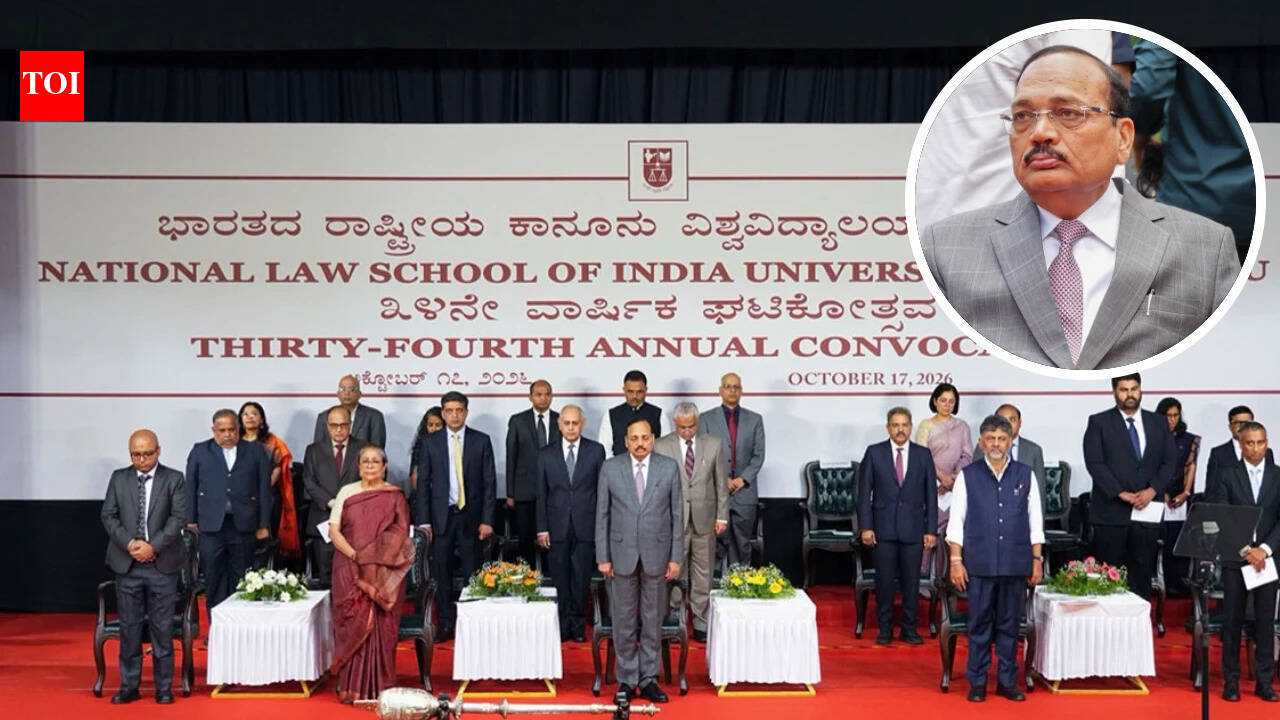
Chief Justice of India Surya Kant disclosed that the recent NLSIU convocation faced uncertainty due to unspecified "external forces" attempting to disrupt it. Despite the challenges, the event was held as scheduled, with the CJI using his address to emphasize the importance of integrity, courage, and intellectual independence for new legal professionals, while Karnataka's Deputy CM al…
Imagine a big party at a special school where smart kids learn about rules and fairness. The main judge of the country, like the head teacher, said that some unknown troublemakers tried to stop the party from happening. But luckily, the party still went on! He then told all the graduating students to be brave, fair, and always listen to everyone, even if they disagree, just like a good referee in a game.
Analysis
Chief Justice of India Surya Kant's recent address at the National Law School of India University (NLSIU) convocation brought to light a concerning development: the threat of disruption by "certain external forces." While the CJI, who also serves as the university's chancellor, did not elaborate on the nature of these forces or the specific circumstances, his remarks indicate a serious attempt to destabilize a significant academic event. The fact that such an event, presided over by the country's highest judicial authority, could face such challenges underscores potential vulnerabilities within public institutions and raises questions about the broader environment in which educational and legal bodies operate.
Surya Kant's Address
In his address to the graduating students, Chief Justice Surya Kant delivered a powerful message emphasizing the core values of the legal profession. He urged the new lawyers to cultivate the courage to defend justice, maintain intellectual independence, and possess the humility to listen to diverse and often unheard viewpoints. The CJI cautioned against compromising principles for convenience or resorting to shortcuts, stressing that the wisdom imparted at NLSIU should serve as their moral compass throughout their careers. This guidance is particularly pertinent in an era where legal professionals often face complex ethical dilemmas and societal pressures.
NLSIU Convocation
Despite the initial uncertainty caused by the external threats, the 34th annual NLSIU convocation in Bengaluru was ultimately held as scheduled. This successful execution, against a backdrop of potential disruption, highlights the resilience of the institution and its commitment to its academic calendar and students. The convocation served as a platform not only for conferring degrees but also for reinforcing the foundational principles of law and justice, as articulated by the Chief Justice. The incident, though vague in its details, serves as a reminder of the constant vigilance required to protect academic freedom and institutional integrity.
DK Shivakumar's Vision
Karnataka Deputy Chief Minister DK Shivakumar, also present at the convocation, echoed the sentiment of responsibility inherent in the legal profession. He urged graduates to view law not merely as a career but as a duty to uphold the Constitution, safeguard citizens' rights, and ensure that justice remains accessible, affordable, and timely for all. Shivakumar also outlined the Karnataka government's plans to bolster the state's legal ecosystem, including establishing a start-up law clinic at NLSIU for pro bono assistance to young entrepreneurs. Additionally, the government intends to create a dedicated institute for judicial service examination training and continuing education for young lawyers, signaling a broader commitment to legal development and support.
Key points
- Chief Justice of India Surya Kant revealed that "certain external forces" threatened to disrupt NLSIU's 34th annual convocation.
- The convocation in Bengaluru ultimately proceeded as scheduled, with degrees conferred to graduating students.
- CJI Surya Kant urged graduates to uphold legal values, intellectual independence, courage, and humility.
- He cautioned against compromising principles for convenience or taking shortcuts in their legal careers.
- Karnataka Deputy Chief Minister DK Shivakumar emphasized law as a responsibility and outlined plans for a start-up law clinic and judicial training institute.
The successful holding of the NLSIU convocation despite the threats demonstrates institutional resilience and a commitment to academic continuity. The Chief Justice's strong emphasis on ethics and intellectual independence could inspire a new generation of lawyers to uphold justice, strengthening the integrity and public trust in India's legal system.
The unspecified nature of the "external forces" that threatened the convocation leaves a lingering concern about potential future disruptions to academic or public events. This ambiguity could foster unease and suggests that underlying vulnerabilities remain unaddressed, potentially inviting further attempts to undermine institutional functions or freedom of expression.