Comcast turns your Xfinity WiFi into a home motion detector
Comcast introduces WiFi-based motion detection as part of its new Xfinity Shield platform, allowing routers and wireless devices to detect people moving through a home without cameras or sensors.
Intelligence analysis by Qwen 2.5 (3B)
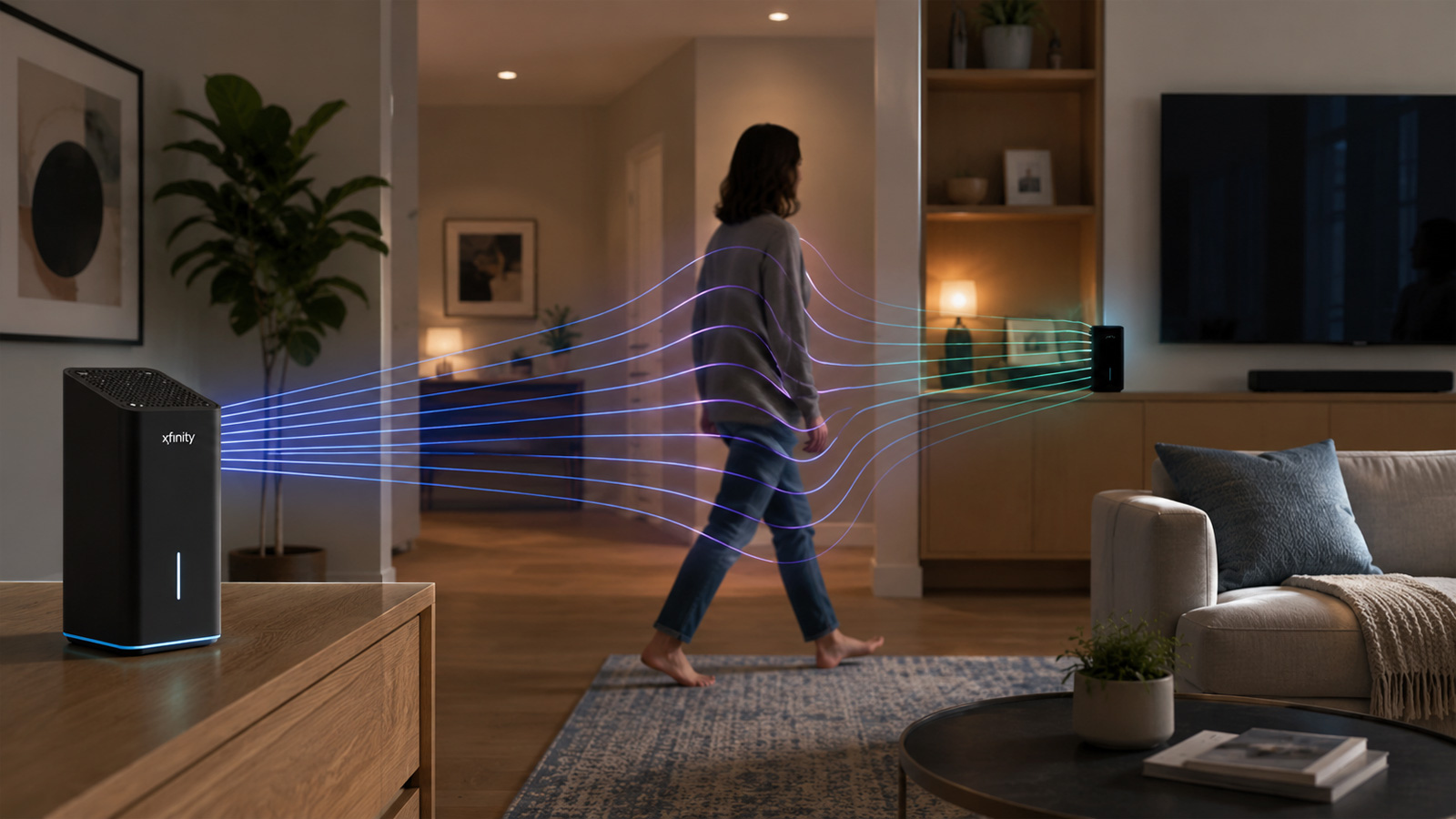
Comcast's Xfinity Shield adds WiFi Motion feature that uses radio signals between gateway and stationary devices to detect movement. Customers receive notifications in the Xfinity app but no visual information on who is moving.
Comcast made WiFi signals act like invisible motion sensors around your home. When someone moves near a device connected to WiFi, their body changes how the WiFi signal travels. Comcast tells you when this happens without showing who is moving.
Analysis
{"#WiFi Motion Technology":"- How WiFi Motion works: The system detects changes in radio frequency signals between an Xfinity Gateway and stationary devices like smart speakers or thermostats. When someone moves through the area, their body alters how these signals travel.","- Sensitivity levels: Comcast offers different sensitivity settings to filter out movement from small pets weighing around 40 pounds or less. For shared spaces, customers can lower sensitivity if unwanted detections occur outside the sensing zone.\n\n##Privacy Concerns":"- Data disclosure: The feature may disclose information generated by WiFi Motion to third parties without further notice in connection with law enforcement investigations or disputes involving Comcast.","- No monitoring of motion or notifications: Comcast states it does not monitor these features and does not retain specific data on who is moving. However, the company's documentation lacks details about what information it could provide in response to a legal demand.\n\n##Legal Implications":"- Legal disclosure: The feature may disclose generated data without notice if used for law enforcement investigations or disputes involving Comcast.","- No retention of specific data: Comcast does not retain specific data on who is moving, but its documentation lacks details about what information it could provide in response to a legal demand. This raises concerns about potential misuse of the system's data.\n\n##User Experience":"- Notifications only: Customers receive notifications through the Xfinity app without visual information on who is moving. The feature does not identify specific people or determine their exact location.","- Shared spaces and pets: For shared apartments, customers can lower sensitivity settings to avoid unwanted detections from small pets or children of similar size. However, this may affect privacy in these situations.\n\n##Future Developments":"- Potential for expansion: Comcast's patent application suggests the technology could be used for more advanced motion detection methods, such as detecting motion from repeated wireless transmissions and motion detection in mesh networks.","- Integration with other features: The feature is part of Xfinity Shield, which combines cybersecurity, physical home monitoring, and family safety features through Xfinity WiFi and the Xfinity app. This integration could lead to further privacy concerns for users who are not aware of these additional features.\n\n##Conclusion":"Comcast's introduction of WiFi Motion as part of its Xfinity Shield platform raises significant privacy concerns, especially in shared spaces or with pets of similar size to children. While the feature is designed to detect motion without identifying specific individuals, it may still have unintended consequences for users' privacy and data security."}
Key points
- Comcast's Xfinity Shield adds WiFi Motion feature that uses radio signals between gateway and stationary devices to detect movement.
- Customers receive notifications in the Xfinity app but no visual information on who is moving.
- WiFi Motion may disclose generated data without notice if used for law enforcement investigations or disputes involving Comcast.
- The feature could have privacy implications, especially in shared spaces or with pets of similar size to children.
WiFi Motion could help families stay safe by alerting them if someone enters or leaves the house. It also allows for better control over notifications and privacy settings.
If attackers get access to WiFi Motion, they might use it to track people without their knowledge. This could lead to privacy violations in shared spaces or with pets of similar size to children.