Congress desires 150 seats in UP Assembly elections; SP offers 53-55 seats
Congress aims to contest at least 150 seats in the upcoming Uttar Pradesh Assembly elections, but its INDIA bloc ally, the Samajwadi Party, is only willing to offer 53-55 seats based on 2024 Lok Sabha election performance.
Intelligence analysis by Gemini 2.5 Flash
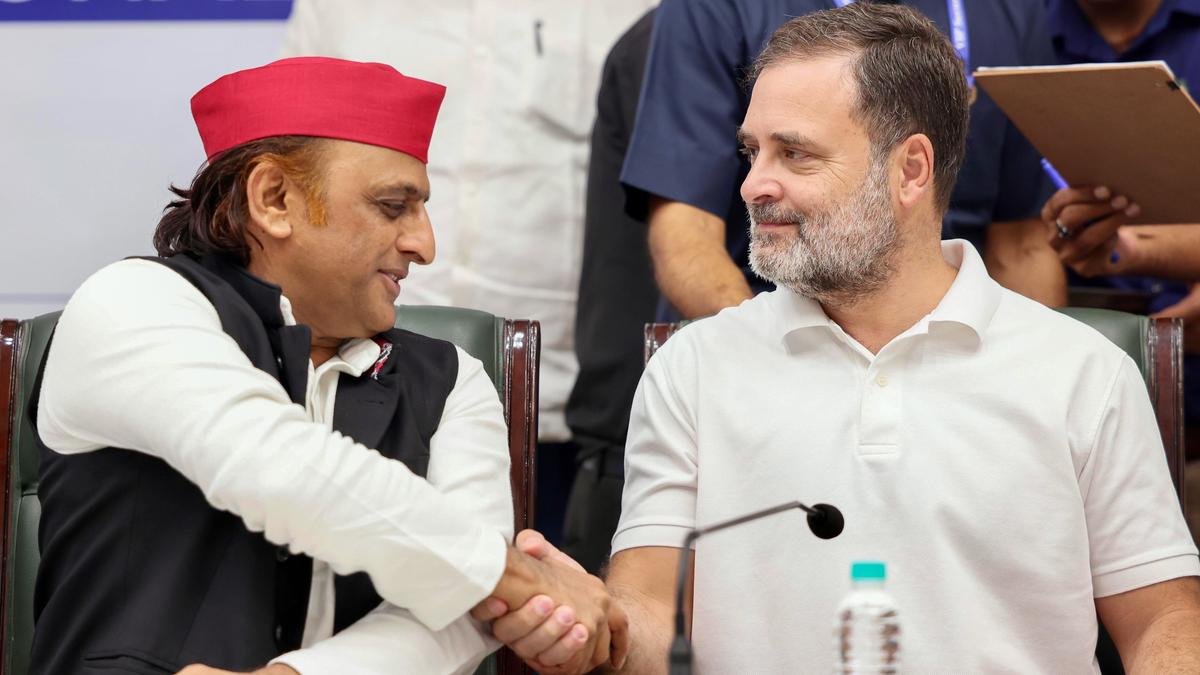
The INDIA bloc faces a significant internal challenge in Uttar Pradesh over seat-sharing for the upcoming Assembly elections. Congress is pushing for a larger share of 150 seats, while the dominant Samajwadi Party, leveraging its 2024 Lok Sabha performance, is firm on allocating only 53-55 seats, intending to contest around 350 itself.
Imagine two friends, Congress and Samajwadi Party, want to play a game in a big playground (Uttar Pradesh). Congress wants to play in 150 areas, but Samajwadi Party, who won more games recently, says, "No, you can only play in about 55 areas, and I'll play in most of the others." They're trying to decide who gets to play where, and it's a bit tricky because both want to win big.
Analysis
150 Seats
The Congress party has clearly articulated its ambition to contest a substantial number of seats in the forthcoming Uttar Pradesh Assembly elections, specifically aiming for a minimum of 150 constituencies. This demand has been publicly voiced by prominent Congress leaders, including Rajendra Pal Gautam, who is in charge of Uttar Pradesh affairs for the party, and Saharanpur MP Imran Masood. Their repeated assertions underscore a strategic push by Congress to re-establish its presence and influence in the politically crucial state, where it has historically struggled to gain significant ground in recent electoral cycles. The party's insistence on a larger share of seats reflects a desire to project itself as a formidable contender rather than a junior partner within the INDIA bloc.
This aggressive stance by Congress is likely driven by an assessment of its potential to mobilize voters and its long-term goals for revival in Uttar Pradesh. By demanding a higher number of seats, Congress aims to secure more opportunities for its candidates and expand its organizational footprint across the state. The public nature of these demands also serves as a tactic to exert pressure on its alliance partner, the Samajwadi Party, during ongoing seat-sharing negotiations. The party believes that a stronger presence in the assembly is vital for its future growth and for effectively challenging the ruling dispensation in the state.
Samajwadi Party
In stark contrast to Congress's aspirations, the Samajwadi Party (SP), a dominant force in Uttar Pradesh and a key constituent of the INDIA bloc, has adopted a much more conservative approach to seat allocation. Reports indicate that the SP is prepared to offer Congress only 53 to 55 seats for the assembly elections. This figure is significantly lower than what Congress is demanding and is rooted in the SP's strategic calculations based on recent electoral performances. The Samajwadi Party's primary objective is to maximize its own electoral gains, and it views the allocation of seats through the lens of winnability and historical performance.
The SP's firm stance suggests a reluctance to concede a larger share of seats, particularly given its own ambitions to contest a vast majority of the 403-member assembly, aiming for approximately 350 constituencies. This strategy highlights the SP's perception of its own strength and its role as the senior partner in the alliance within Uttar Pradesh. Despite the pressure from Congress leaders, the Samajwadi Party appears unwilling to deviate significantly from its proposed formula, indicating a clear prioritization of its own political interests and a pragmatic assessment of the alliance's collective strength.
2024 Lok Sabha Elections
The basis for the Samajwadi Party's proposed seat-sharing formula is explicitly tied to the results of the 2024 Lok Sabha elections. The SP's analysis of these results forms the bedrock of its argument for allocating a limited number of seats to Congress. In the 2024 general elections, Congress managed to secure victories in six Lok Sabha seats within Uttar Pradesh. These six parliamentary constituencies collectively encompass more than thirty assembly segments, which the SP acknowledges as areas where Congress demonstrated electoral strength.
Furthermore, the SP's assessment extends to the eleven assembly constituencies that fall under Lok Sabha seats where Congress contested but ultimately lost. By evaluating Congress's performance in these specific assembly segments, the Samajwadi Party has arrived at its conclusion regarding the optimal number of seats to offer. Conversely, the Samajwadi Party itself achieved a significant victory in 37 Lok Sabha seats in 2024 and also performed well in assembly segments within the Lok Sabha constituencies where it did not win. This strong performance in the recent general elections provides the SP with a robust justification for its plan to contest around 350 assembly seats, reinforcing its position in the ongoing alliance negotiations.
Key points
- Congress seeks to contest at least 150 seats in the Uttar Pradesh Assembly elections.
- The Samajwadi Party (SP) is willing to offer Congress only 53-55 seats.
- SP's seat-sharing formula is based on the 2024 Lok Sabha election results.
- SP plans to contest approximately 350 of the 403 assembly seats.
- Congress leaders are reportedly pressuring SP, but SP is firm on its formula.
If the two parties successfully negotiate a mutually agreeable seat-sharing formula, it could strengthen the INDIA bloc's unity and present a more formidable challenge to the ruling party in Uttar Pradesh, potentially improving their electoral prospects. A united front could consolidate opposition votes and leverage each party's regional strengths.
A failure to resolve the seat-sharing dispute could lead to internal friction, with one or both parties potentially contesting independently or with reduced enthusiasm for the alliance. This disunity could split opposition votes, weaken their collective impact, and ultimately benefit the incumbent party in the Uttar Pradesh Assembly elections.