Dung beetles bring poo-sitive news about animals in Central Catchment Nature Reserve
Researchers in Singapore have found that dung beetles can help identify elusive wildlife by analyzing DNA from their gut contents. The study, conducted in the Central Catchment Nature Reserve, detected 18 animal species, including rare mammals and birds. The findings sugg…
Intelligence analysis by Llama
Dung beetles in Singapore's Central Catchment Nature Reserve help identify elusive wildlife by analyzing DNA from their gut contents. The study detected 18 animal species, including rare mammals and birds, and suggests that dung beetles can be used as a DNA resource for surveying wildlife in tropical forests.
Dung beetles in Singapore's Central Catchment Nature Reserve help scientists identify animals that are hard to find. They do this by eating animal poop and then giving scientists a sample of the animal's DNA. This helps scientists understand which animals live in the forest and how they interact with each other.
Analysis
Dung Beetles as a Tool for Biodiversity Monitoring
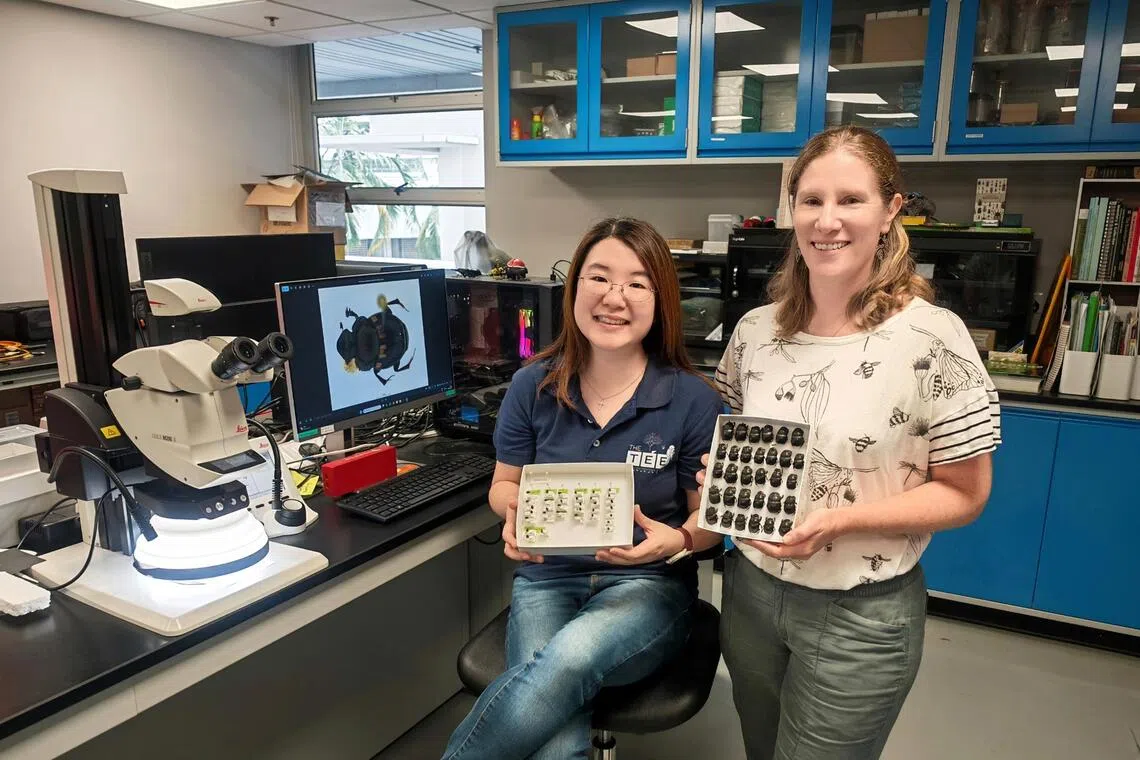
Dung beetles have long been known to play a crucial role in breaking down animal faeces, but their unusual diet can also give clues about the elusive mammals and birds that roam the forests. In a recent study, researchers from the Nanyang Technological University (NTU) used dung beetles to identify 18 animal species, including rare mammals and birds, in the Central Catchment Nature Reserve.
The study, led by associate professor Eleanor Slade and research fellow Ong Xin Rui, involved placing 100 traps made of plastic bottles and disposable plates on the forest floor and canopies across 50 sites in the reserve. The traps were baited with human faeces, wrapped in cloth, to attract dung beetles. Each trap was left in the field for 24 hours before the researchers returned to collect the beetles.
The team estimates that there are around 25 dung beetle species in Singapore, including those that are new to science. After dissecting the beetles, Ong and her team separated the half-digested materials from their stomachs and transferred them inside solutions that amplify the DNA of mammals and vertebrates such as birds and frogs.
The samples were sent to a company that sequenced or mapped the DNA found in the beetles' guts. A total of 18 animal species were detected through DNA matching, including the elusive sambar deer, Sunda pangolin and Sunda slow loris. Other wildlife detected include the brahminy kite – a bird of prey – and a few squirrel and frog species, such as the black-eyed litter frog.
The study has significant implications for conservation and ecological research in tropical forests. It shows that dung beetles can be used as a tool for monitoring biodiversity and understanding animal interactions in forest ecosystems. The researchers plan to improve DNA collection methods by non-invasive swabbing and have discovered new dung beetle species, advancing conservation and ecological research in tropical forests.
Mapping Food Webs
The study can also map food webs by analyzing the DNA found in the beetles' guts. Ong noted that the study can also map food webs, highlighting how the study can also map food webs. The research findings were published in scientific journal Molecular Ecology Resources.
Implications for Conservation
The study has significant implications for conservation and ecological research in tropical forests. It shows that dung beetles can be used as a tool for monitoring biodiversity and understanding animal interactions in forest ecosystems. The researchers plan to improve DNA collection methods by non-invasive swabbing and have discovered new dung beetle species, advancing conservation and ecological research in tropical forests.
Key points
- Dung beetles can be used as a tool for monitoring biodiversity and understanding animal interactions in forest ecosystems.
- The study detected 18 animal species, including rare mammals and birds, in the Central Catchment Nature Reserve.
- The study has significant implications for conservation and ecological research in tropical forests.
- The researchers plan to improve DNA collection methods by non-invasive swabbing and have discovered new dung beetle species.
- The study can also map food webs by analyzing the DNA found in the beetles' guts.
The study's findings have significant implications for conservation and ecological research in tropical forests. The use of dung beetles as a tool for monitoring biodiversity and understanding animal interactions in forest ecosystems could lead to more effective conservation efforts and a better understanding of the complex relationships between species in these ecosystems.
The study's findings also highlight the potential risks associated with the use of dung beetles as a tool for monitoring biodiversity. For example, the collection of dung beetles could potentially disrupt the ecosystem, leading to unintended consequences. Additionally, the study's findings could be used to justify the destruction of habitats, leading to further loss of biodiversity.