Fazl sets conditions for mediating between govt, opposition
JUI-F chief Maulana Fazlur Rahman has set conditions for mediating between the government and opposition, who have both agreed on his potential role.
Intelligence analysis by Gemini 2.5 Flash
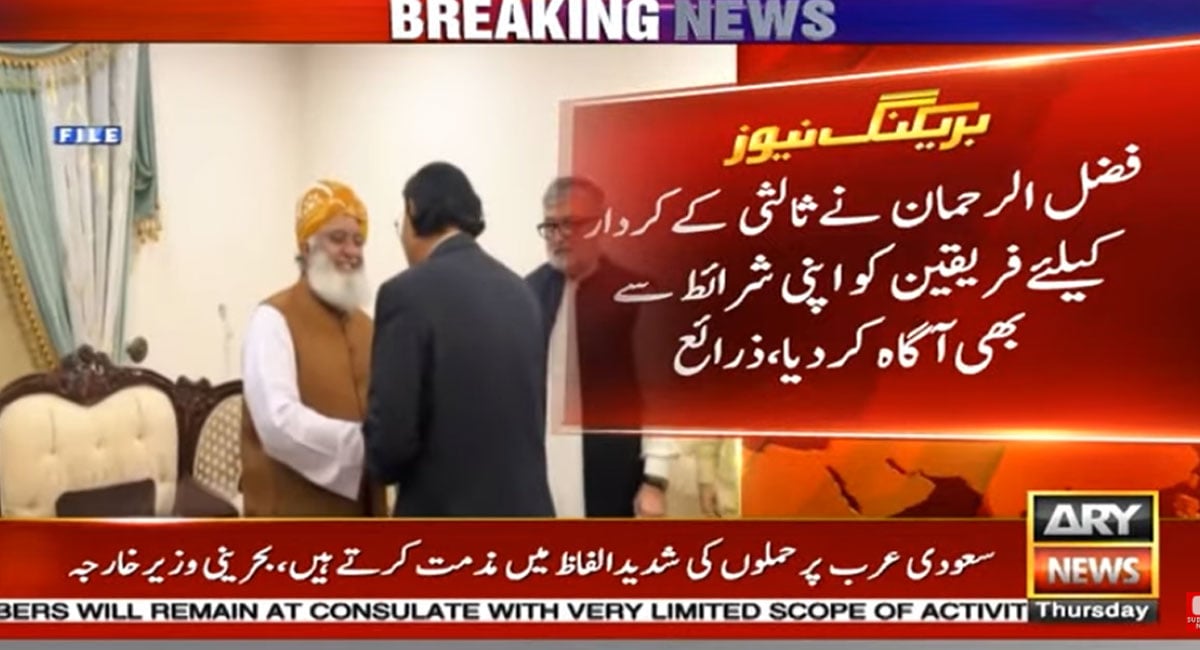
Maulana Fazlur Rahman has been approached by both the government and opposition to mediate their political deadlock. He has laid out conditions, including assessing their seriousness and commitment to a solution, before formally accepting the role, emphasizing that a resolution is possible with sincere effort and mutual recognition.
Imagine two groups of friends are arguing a lot, and they can't agree on anything. A wise older friend, Maulana Fazlur Rahman, has offered to help them talk and make up. But first, he wants to make sure both groups are really serious about being friends again and not just pretending. If they show they truly want to solve their problems, he'll help them find a way to get along.
Analysis
Maulana Fazlur Rahman
Maulana Fazlur Rahman, the chief of Jamiat Ulema-e-Islam-Fazl (JUI-F), has emerged as a pivotal figure in the ongoing political impasse between Pakistan's government and opposition. Both sides have reportedly agreed on his name as a potential mediator, approaching him to help resolve the deadlock. Rahman, however, has not immediately accepted the role, instead setting forth specific conditions that underscore his cautious approach to the sensitive task.
His primary condition involves assessing the seriousness and commitment of both the government and opposition to finding a genuine solution. He has conveyed to the parties that he will only proceed with mediation if they demonstrate a sincere effort and are willing to recognize each other's positions. This stance highlights his intent to ensure that any mediation is not merely a superficial exercise but a concerted attempt to bridge fundamental differences, warning that continued deadlock and the use of force would only exacerbate the situation.
Pakistan Tehreek-e-Insaf
The call for mediation comes amidst a backdrop of escalating political tensions, notably with the Pakistan Tehreek-e-Insaf (PTI) planning a 'long march' towards Islamabad. PTI Chairman Barrister Gohar Ali Khan recently called for unconditional talks with the government, a move that followed Prime Minister Shehbaz Sharif's offer of dialogue contingent on the PTI ending its march. Khan, however, insisted that negotiations should continue uninterrupted, even if the long march reaches the capital.
This divergence in conditions for dialogue—the government's demand for the march to end versus PTI's insistence on unconditional talks—underscores the deep mistrust and fundamental disagreements between the political rivals. The PTI's determination to proceed with its march, traveling from Peshawar to Khyber and then to Pir Wadhai in Rawalpindi, signals their intent to maintain pressure, complicating any mediatory efforts that might seek to de-escalate the street protests.
Peshawar High Court
Adding another layer to the political landscape, the Peshawar High Court (PHC) has issued a notice to Khyber Pakhtunkhwa Chief Minister Sohail Afridi. The notice seeks a response regarding the alleged use of government resources for the ongoing Pakistan Tehreek-e-Insaf (PTI) long march. This legal scrutiny arose from a petition filed by PML-N MPA Qari Zahir, contending that state resources were being improperly utilized to support the opposition's protest.
The PHC's intervention introduces a judicial dimension to the political confrontation, potentially impacting the logistics and legitimacy of the PTI's long march. The court's inquiry could either validate concerns about resource misuse or clear the provincial government, but in either case, it adds another pressure point to an already volatile political environment, further complicating the path towards a negotiated settlement.
Key points
- JUI-F chief Maulana Fazlur Rahman has been approached by both the government and opposition to mediate their political deadlock.
- Fazlur Rahman has set conditions for mediation, including assessing the seriousness and commitment of both parties to finding a solution.
- He emphasized that a resolution is possible if both sides make sincere efforts and recognize each other's positions.
- PTI Chairman Barrister Gohar Ali Khan has called for unconditional talks, contrasting with PM Shehbaz Sharif's offer conditioned on ending the long march.
- The Peshawar High Court has issued a notice to KP CM Sohail Afridi regarding the alleged use of government resources for the PTI long march.
If Maulana Fazlur Rahman successfully mediates, it could lead to a significant de-escalation of political tensions in Pakistan. A constructive dialogue between the government and opposition might result in a mutually acceptable resolution, potentially averting the planned long march and fostering greater political stability.
Should the mediation efforts fail, or if either side proves unwilling to compromise on Fazlur Rahman's conditions, the political deadlock could intensify. This might lead to the opposition's long march proceeding as planned, potentially resulting in confrontations and further instability, especially if force is used to stop the protest.