Food scientist who turned soya pulp to food among 14 recipients of Singapore eco award
Food scientist Heng Kiang Soon developed ways to turn soya pulp into ingredients for human food and agricultural use, among other products. He was among 14 people presented with the EcoFriend award for their significant contributions to making Singapore more sustainable.
Intelligence analysis by Llama
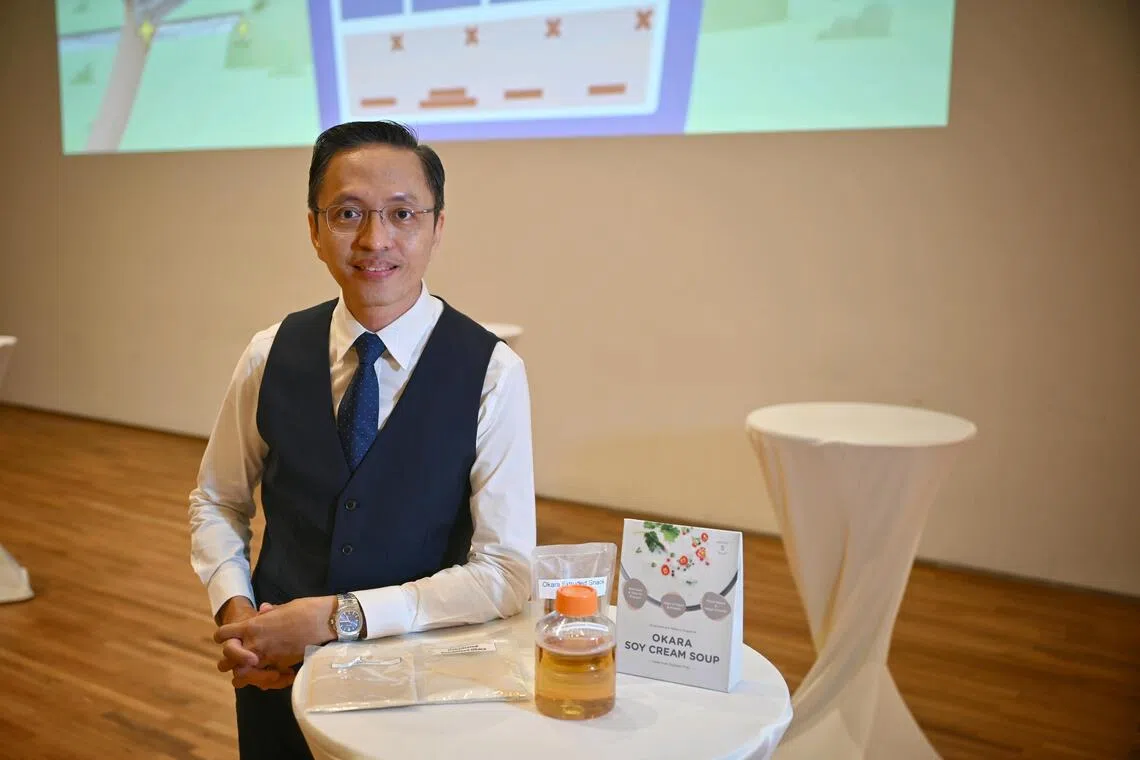
Food scientist Heng Kiang Soon turned soya pulp into 14 food and agricultural products, earning him the EcoFriend award for his contributions to making Singapore more sustainable.
A food scientist in Singapore turned soya pulp into useful products like soya cheese and plant boosters. This helps reduce waste and can create new business opportunities.
Analysis
Maximising Resource Utilisation in Singapore
Food scientist Heng Kiang Soon has made significant contributions to making Singapore more sustainable by developing ways to turn soya pulp into ingredients for human food and agricultural use, among other products. This innovation can help reduce waste, generate new business opportunities, and build stronger food system resilience in Singapore.
Heng's technology makes the soya pulp soluble and turns it into 14 food and agricultural products, including soya cheese, soya cream soup, and plant boosters. The plant boosters can enhance crop yield and quality. Some of these products have been licensed for commercialisation, said Heng, a specialist in food innovation and lecturer at Republic Polytechnic's School of Applied Science.
On Aug 18, Heng was among 14 people presented with the EcoFriend award, which recognises individuals from the private and public sectors, educational institutions, grassroots, and non-governmental organisations for their significant contributions to making Singapore more sustainable.
Unlocking Solutions for Society and the Environment
Converting by-products like soya pulp into useful products is not only environmentally friendly but can also help to generate new business opportunities and build stronger food system resilience, said Heng, who grew up on a farm in Malaysia.
"If we learn to see waste not as something to throw away but as a resource with untapped potential, we can unlock solutions that benefit both society and the environment," added the 50-year-old, who is also looking to recycle other food waste like spent coffee grounds and fruit pulp.
Inspiring the Next Generation
Another award recipient is Dazhong Primary School teacher Ong Xuan Wan, who created an experiential learning platform to spark her pupils' curiosity about science and sustainability. The platform features eco-trails and Pokemon-inspired mascots that guide pupils through hands-on learning to find out more about the fauna and flora in the school, as well as how to recycle, among other topics.
"Our environment belongs to the next generation. It is their belief and actions that will decide the future of Singapore and how well we care for our environment," said the 39-year-old.
"I want to plant a seed in every pupil so that it will remind them of the impact of their action or inaction when they grow up," added Ong.
Key points
- Food scientist Heng Kiang Soon developed ways to turn soya pulp into ingredients for human food and agricultural use.
- He was among 14 people presented with the EcoFriend award for their significant contributions to making Singapore more sustainable.
- Heng's innovation can help reduce waste, generate new business opportunities, and build stronger food system resilience in Singapore.
Heng's innovation can lead to cost savings and generate new business opportunities in the food industry. It can also inspire others to think creatively about reducing waste and promoting sustainability.
However, there are challenges to scaling up Heng's technology, such as the need for significant investment in infrastructure and the potential for resistance from established industries.