Iran's president says Tehran will reciprocate if US honours interim deal commitments
Iranian President Masoud Pezeshkian stated that Tehran would immediately reciprocate if the United States honored its commitments under an interim deal signed in June, following recent direct attacks between the two nations.
Intelligence analysis by Gemini 2.5 Flash
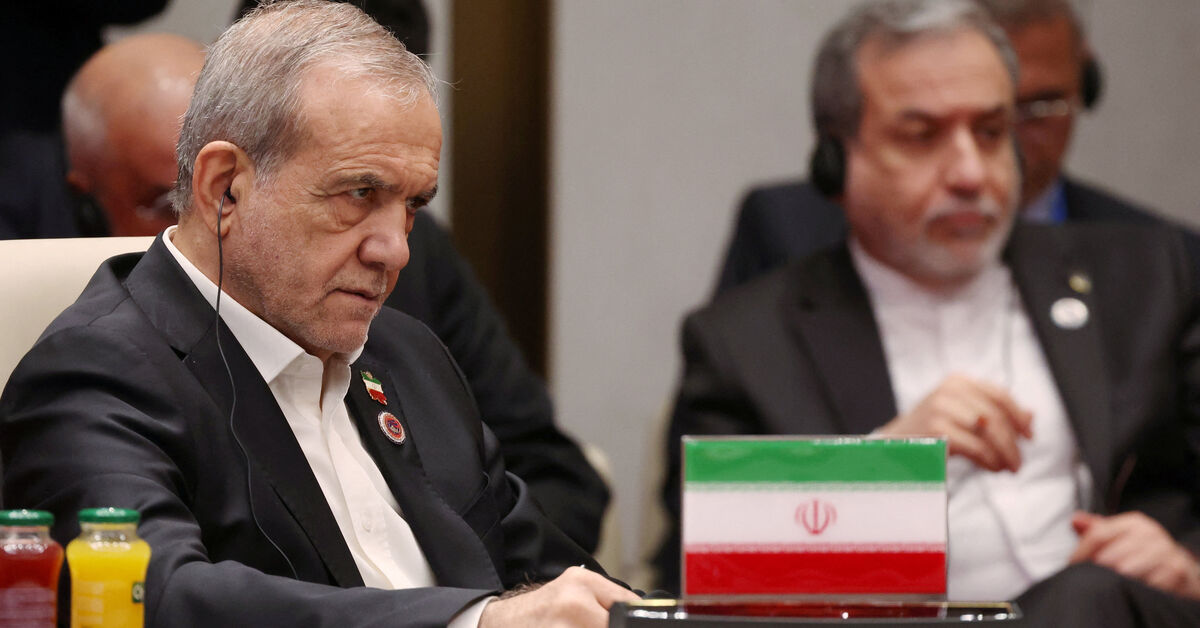
President Pezeshkian made his remarks at the Shanghai Cooperation Organisation Summit, emphasizing Iran's willingness for a negotiated solution despite recent military exchanges, including US strikes on Larak Island and Iranian attacks on US air bases in Jordan. The interim deal, aimed at ending the conflict that began in February, quickly unraveled due to implementation disagreements…
Imagine two friends who had a big fight, and they tried to make a promise to be nice to each other again. But then they started arguing about who should go first. Now, one friend, Iran's President, is saying, "Hey, if you (the US) keep your promise from before, we'll keep ours right away!" This is important because they've been having little fights again, and their promise could stop bigger problems, especially since they live near a very important sea road where lots of oil ships travel.
Analysis
Masoud Pezeshkian
Iranian President Masoud Pezeshkian's recent statements at the Shanghai Cooperation Organisation (SCO) summit in Bishkek underscore Tehran's conditional readiness for de-escalation with the United States. His declaration that Iran would "immediately reciprocate" if the US honored its commitments under an interim deal signals a diplomatic opening, albeit one contingent on Washington's actions. This public stance comes shortly after a significant escalation in the US-Iran conflict, marked by direct military exchanges in late July and early September, including US strikes on Larak Island and Iranian responses targeting US air bases in Jordan.
Pezeshkian's emphasis that "war was in no one's interest" and that Tehran remains "open to a negotiated solution" suggests a strategic effort to project a willingness for peace while maintaining a firm position on the interim agreement. His presence and remarks at the SCO summit also highlight Iran's broader diplomatic engagements and its efforts to leverage multilateral platforms to articulate its foreign policy objectives amidst ongoing tensions with Western powers. The timing of these statements, following renewed hostilities, indicates a calculated move to re-establish a framework for dialogue.
Strait of Hormuz
The strategic importance of the Strait of Hormuz, a critical chokepoint for global oil supplies, features prominently in Iran's leverage strategy concerning the interim deal. Tehran has consistently asserted that it will only guarantee free navigation through this vital waterway if Washington adheres to the terms of the June agreement. This conditionality links a crucial aspect of international commerce and energy security directly to the bilateral dispute, raising stakes for global markets and international diplomacy.
Any disruption or threat to navigation in the Strait of Hormuz has immediate and far-reaching implications for the global economy, particularly for oil prices and supply chains. Iran's repeated articulation of this stance serves as a powerful reminder of its capacity to influence international trade and its willingness to use this leverage in negotiations. The implicit threat underscores the urgency for both sides to find a resolution, as the economic consequences of an unfulfilled deal extend beyond the immediate parties.
Interim Deal
The interim deal, signed between Tehran and Washington in June, was initially conceived as a mechanism to de-escalate the conflict that commenced with US and Israeli strikes on Iran on February 28. However, the agreement quickly "unravelled amid disagreements over its implementation," indicating significant hurdles in translating diplomatic understanding into practical action. President Pezeshkian's current call for the US to return to its commitments suggests that Iran views the existing framework as a viable, albeit stalled, pathway to resolution.
The specifics of the deal's commitments, while not fully detailed in the article, are clearly central to Iran's current demands. The failure of its initial implementation highlights the deep mistrust and complex issues that plague US-Iran relations, requiring robust verification and mutual confidence-building measures. Reviving this deal would necessitate a clear understanding and adherence to its terms by both parties, potentially offering a structured approach to managing their ongoing conflict and preventing further military escalation.
Key points
- Iranian President Masoud Pezeshkian stated Iran would reciprocate if the US honors an interim deal signed in June.
- The statement follows recent direct military exchanges between the US and Iran, including strikes on Larak Island and US air bases in Jordan.
- The interim deal, aimed at ending the conflict that began in February, quickly unraveled due to implementation disagreements.
- Tehran has linked free navigation through the vital Strait of Hormuz to the US implementing the terms of the agreement.
- Pezeshkian emphasized that war is not in anyone's interest and Iran remains open to a negotiated solution.
If the United States honors its commitments under the interim deal, Iran's stated willingness to reciprocate could lead to a significant de-escalation of tensions. This mutual adherence to the agreement could pave the way for a negotiated solution to the broader conflict, fostering greater stability in the Middle East and ensuring the unimpeded flow of global oil supplies through the Strait of Hormuz.
Should the United States fail to honor its commitments or if disagreements over the interim deal's implementation persist, the current tensions could escalate further. This could lead to renewed direct military confrontations, potentially disrupting navigation in the vital Strait of Hormuz and triggering a broader regional conflict with severe global economic repercussions.
Market signals
- OIL Iran's conditional threat regarding the Strait of Hormuz, a vital waterway for global oil supplies, introduces supply-route risk that could push oil prices higher.
AI-generated analysis of potential market relevance. Not financial advice.