NVIDIA Unveils Minerva to Bring End-to-End Observability for AI Factories
NVIDIA launched Minerva, an AIOps platform designed to enhance AI factory productivity by providing end-to-end observability. It integrates infrastructure and AI workload telemetry, using AI models to identify issues early and streamline operations.
Intelligence analysis by Gemini 2.5 Flash Lite
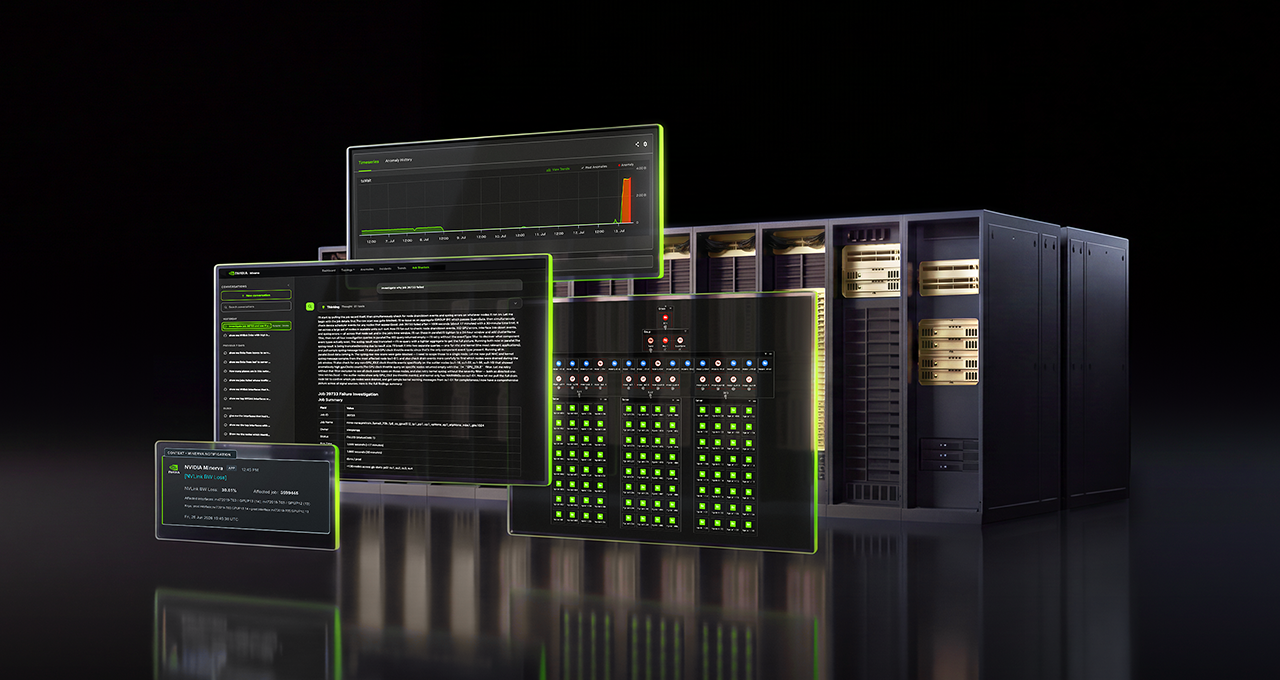
NVIDIA's new Minerva platform aims to optimize AI factories by offering unified observability across complex infrastructure. It correlates data from GPUs, networking, and storage with AI workloads, using AI to detect anomalies, predict failures, and group alerts into actionable incidents, thereby maximizing GPU uptime and operational efficiency.
Imagine a giant factory that builds super-smart computer brains (AI). This factory has tons of special computer parts working together. NVIDIA's new tool, Minerva, is like a super-smart supervisor that watches all the parts. It uses AI to spot tiny problems, like a part getting too hot, before they stop the whole factory. This helps the factory make more AI brains faster and without as many breaks.
Analysis
Minerva Platform
NVIDIA's Minerva platform represents a significant advancement in the operational management of AI factories, which are characterized by their immense scale and complexity, involving vast arrays of GPUs, high-speed networking, and intricate storage systems. Traditional monitoring tools often operate in silos, with separate teams managing compute, networking, and storage, leading to fragmented visibility. Minerva aims to bridge this gap by consolidating telemetry data from all these components, alongside AI workload performance metrics. This unified data stream is then processed by purpose-built AI models, including supervised and unsupervised machine learning algorithms, to analyze billions of data points hourly. The platform's core innovation lies in its ability to learn normal operational behavior, detect subtle anomalies that might otherwise go unnoticed, predict impending failures, and correlate seemingly disparate events based on the factory's logical topology. This allows for the transformation of an overwhelming 'event storm' into a focused incident with a clearly identified root cause, significantly simplifying the diagnostic process for operators.
AI Factory Yield
The primary objective of Minerva is to maximize 'AI factory yield,' a metric that quantifies the useful work produced by the infrastructure. This is measured through key performance indicators such as GPU hours, goodput (the amount of useful data processed), cluster uptime, and token production, particularly relevant for large language models. By providing end-to-end observability, Minerva enables a shift from reactive troubleshooting to proactive maintenance. The platform's ability to correlate infrastructure issues with workload performance is crucial. For instance, it can trace a slowdown in a training job directly to a specific component, even in a factory with hundreds of thousands of GPUs. This granular insight allows teams to address problems before they escalate, leading to longer uninterrupted job runs and faster repair times when incidents do occur. The platform also integrates a native AI assistant and supports external agentic AI tools, offering a natural-language interface for investigating cluster health and receiving remediation recommendations, further streamlining operations.
Partner Ecosystem
Minerva is being adopted by a range of industry players, signaling its potential impact on the AI infrastructure landscape. Companies like IREN, Aolani, Bitdeer AI, IBM, Jio, Lambda, Quake AI, and Tesla are planning to deploy the platform to optimize their AI operations. IREN's CTO, Denis Skrinnikoff, highlighted Minerva's role in providing a single, unified view across their network, GPUs, and jobs, enabling a focus on proactive maintenance. Furthermore, hardware manufacturers such as Dell Technologies, Lenovo, and Supermicro will offer Minerva as part of their AI factory solutions. This broad adoption and integration into hardware portfolios suggest that Minerva is positioned to become a foundational element for managing the next generation of large-scale AI deployments, addressing the growing challenges of complexity and efficiency in AI infrastructure.
Key points
- NVIDIA launched Minerva, an AIOps platform for AI factory observability.
- It integrates telemetry from infrastructure and AI workloads to identify issues early.
- Minerva aims to maximize AI factory yield by improving GPU uptime and reducing downtime.
- The platform uses AI models to analyze data, detect anomalies, and predict failures.
- Several tech companies and hardware manufacturers are adopting or will offer Minerva.
Minerva's adoption by major tech players and hardware manufacturers suggests it could become a standard for managing complex AI infrastructure, leading to more reliable and efficient AI development. This could accelerate the deployment of advanced AI applications by reducing operational bottlenecks and improving resource utilization.
The complexity of integrating Minerva across diverse AI factory setups could present significant challenges, potentially leading to slow adoption or implementation issues. If the AI models within Minerva are not sufficiently robust or if data integration proves difficult, the promised end-to-end observability might not be fully realized, leaving some operational blind spots.


