Syria and Jordan sign 11 agreements to strengthen economic ties
Syria and Jordan have signed 11 agreements to bolster economic cooperation across sectors like agriculture, transport, and energy, following a significant increase in bilateral trade in 2025.
Intelligence analysis by Gemini 2.5 Flash
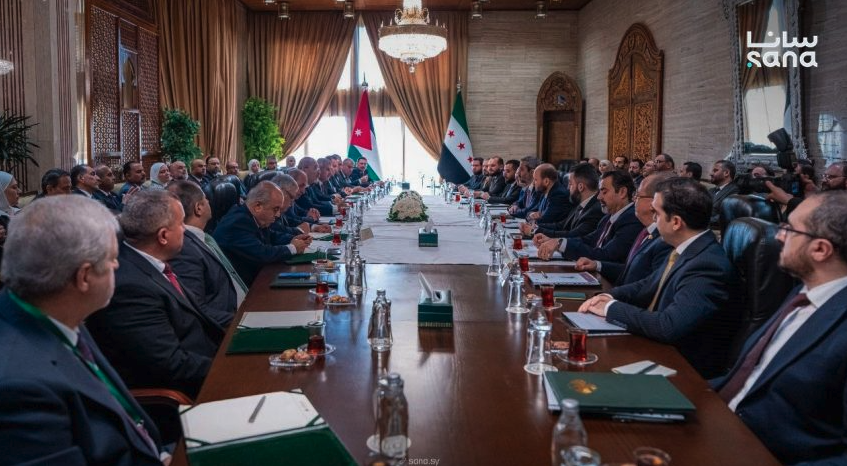
The agreements, comprising memoranda of understanding, executive programs, and a cooperation protocol, aim to enhance food security, investment, and infrastructure. Discussions also covered establishing a joint economic city, improving trade logistics, and coordinating energy supplies, signaling a concerted effort to deepen economic integration between the two nations.
Imagine two neighboring countries, Syria and Jordan, are like two friends who want to help each other out. They've signed 11 special agreements, like making a bunch of promises, to trade more things like food and building materials, and even share energy. It's like they're building a bigger, stronger bridge between their homes so more trucks can go back and forth easily, helping both their families get what they need and grow stronger together.
Analysis
11 Agreements
Syria and Jordan have formalized their commitment to enhanced economic cooperation by signing a comprehensive package of 11 agreements. These deals span a wide array of critical sectors, including agriculture, transport, energy, investment, and higher education. The agreements are structured as eight memoranda of understanding, two executive programs, and one cooperation protocol, reflecting a multi-faceted approach to fostering deeper ties. This broad scope underscores a strategic intent to address various economic challenges and opportunities collaboratively, moving beyond singular issues to encompass a holistic framework for bilateral development.
The focus on areas such as food security, water management, and environmental protection highlights shared priorities in sustainable development and resource management. Furthermore, the inclusion of public administration, civil aviation, and scientific research points to an ambition to modernize and integrate administrative and intellectual capacities. These agreements are not merely symbolic; they lay the groundwork for practical initiatives aimed at improving the livelihoods of citizens and strengthening the economic resilience of both nations. The comprehensive nature of these accords suggests a long-term vision for partnership.
334 Million Jordanian Dinars
The signing of these agreements comes against a backdrop of significantly increasing trade volumes between Syria and Jordan. Bilateral trade reached 334 million Jordanian dinars ($471 million) in 2025, marking a nearly threefold increase from 116 million dinars recorded in 2024. This substantial growth provides a strong economic impetus for the newly signed agreements, demonstrating existing momentum that the new protocols aim to accelerate and solidify. The figures, reported by the Amman Chamber of Commerce, indicate a robust and expanding commercial relationship that both governments are keen to support and expand.
Jordanian exports to Syria, totaling 252 million dinars, were primarily driven by construction and industrial products, including cement, iron, marble, and specialized chemical products, reflecting Syria's ongoing reconstruction needs. Conversely, imports from Syria, amounting to 82 million dinars, largely consisted of agricultural commodities and raw materials. This complementary trade structure suggests a natural synergy between the two economies, where each can supply goods and resources vital to the other. The council's emphasis on addressing technical, logistical, and legislative challenges affecting trade flows indicates a proactive approach to sustaining and further boosting this positive trend.
Risha Gas Field
Energy cooperation emerged as a pivotal component of the discussions, with specific attention paid to meeting Syria's natural gas requirements. A key proposal involves the possibility of supplying industrial facilities in southern Syria with compressed natural gas from Jordan’s Risha gas field. This initiative could provide a crucial energy source for Syrian industries, supporting their operational capacity and contributing to economic recovery. The discussions also explored the potential use of storage capacity in Jordan’s Madouna area for supplying southern Syrian regions with petroleum products, alongside the transfer of Jordanian expertise in liquefied natural gas storage and regasification, showcasing a comprehensive energy partnership.
Beyond direct supply, the two countries deliberated on coordinating Syria’s gas requirements for 2027 and arrangements for transporting natural gas to Lebanon through Syrian territory. This broader regional energy strategy includes the possibility of utilizing gas supplied from Jordan to generate electricity at Syrian power plants, with the resulting electricity then exported to Lebanon. Such trilateral coordination underscores the potential for Jordan and Syria to play a more integrated role in regional energy networks, enhancing energy security and economic interdependence across the Levant. The commitment to finalize technical, commercial, and contractual arrangements highlights the practical steps being taken to realize these ambitious energy projects.
Key points
- Syria and Jordan signed 11 agreements covering sectors including agriculture, transport, energy, and investment.
- Bilateral trade nearly tripled from 116 million Jordanian dinars in 2024 to 334 million dinars in 2025.
- Discussions included establishing a joint economic city along the border and expanding the Syrian-Jordanian Joint Free Zone.
- Energy cooperation focuses on supplying Syria's natural gas needs, potentially from Jordan's Risha gas field, and coordinating gas requirements for 2027.
- Plans are underway to advance a regional railway corridor linking Syria, Jordan, Saudi Arabia, and Turkiye, and upgrade border crossings.
The signing of these agreements could significantly boost economic recovery and stability in both Syria and Jordan, fostering increased trade, investment, and job creation. Enhanced cooperation in energy and infrastructure, such as the regional railway corridor, could lead to greater regional connectivity and shared prosperity.
Despite the agreements, geopolitical complexities and potential funding challenges for large-scale projects like the joint economic city or railway could hinder full implementation. Ongoing instability in the region might also deter foreign investment, limiting the intended economic benefits.