US cannot be trusted in talks: Pezeshkian
Iranian President Pezeshkian declared negotiations with the US 'meaningless,' citing a pattern of US attacks and broken commitments following previous talks.
Intelligence analysis by Gemini 2.5 Flash
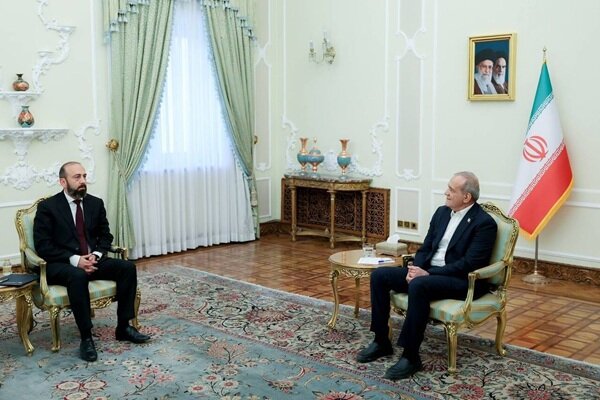
During a meeting with Armenia's Foreign Minister Ararat Mirzoyan, Iranian President Pezeshkian asserted that Iran cannot trust the United States, accusing Washington of resorting to war, assassinations, sanctions, and threats immediately after negotiations, with the ultimate goal of overthrowing the Islamic Republic.
Imagine you're playing a game with someone, and every time you try to talk about the rules, they suddenly try to trip you or take your toys. Iran's President, Pezeshkian, feels like the United States keeps doing that. He says they talk, but then the US attacks or puts pressure on Iran, making him think the US isn't really interested in playing fair, but just wants to stop Iran from playing at all. So, he thinks talking to them is pointless.
Analysis
Iranian President Pezeshkian's recent remarks to Armenia's Foreign Minister Ararat Mirzoyan highlight a profound and long-standing distrust of the United States, framing any potential negotiations as futile. His assertion that the US consistently responds with aggression, including 'war,' 'assassination,' 'sanctions,' and 'threats,' immediately after engaging in dialogue, paints a picture of a relationship mired in hostility and suspicion. This perspective is crucial for understanding Iran's reluctance to re-engage in direct talks with Washington, particularly concerning its nuclear program or regional security issues.
Pezeshkian
President Pezeshkian articulated a clear and uncompromising stance regarding the United States, stating that Iran has faced attacks three times after talks, which he interprets as evidence that the US is not genuinely seeking dialogue. He firmly believes that the ultimate objective of the US is the overthrow of the Islamic Republic of Iran, rather than a peaceful resolution or diplomatic engagement. This conviction shapes his administration's approach to international relations, prioritizing self-reliance and seeking alliances with nations perceived as more trustworthy.
His comments reflect a deeply ingrained historical narrative within Iran, where past diplomatic overtures have often been followed by increased pressure or perceived betrayals from the US. Pezeshkian's emphasis on broken commitments and continuous hostile actions reinforces the idea that the US cannot be a reliable partner in any negotiation. This rhetoric is likely to resonate with a domestic audience that has experienced decades of sanctions and geopolitical tensions, solidifying support for a hardline foreign policy.
Ararat Mirzoyan
The context of these strong statements was a meeting with Armenia's Foreign Minister Ararat Mirzoyan, who was on an official visit to Tehran. While Pezeshkian used the opportunity to express his views on US-Iran relations, he also called for the expansion of trade ties with Armenia. This dual message indicates Iran's strategy of simultaneously condemning perceived adversaries while actively pursuing strengthened diplomatic and economic relationships with regional partners.
Mirzoyan's visit and the call for enhanced trade underscore Iran's efforts to build a network of allies and economic partners, particularly in its immediate neighborhood, to counter international isolation. Expanding ties with countries like Armenia can provide Iran with alternative trade routes and diplomatic leverage, reducing its vulnerability to external pressures. This regional focus is a key component of Iran's foreign policy, aiming to create a more resilient and interconnected economy less dependent on Western interactions.
Islamic Republic of Iran
The Iranian President's declaration that the US aims to overthrow the Islamic Republic of Iran is a foundational element of Tehran's geopolitical outlook. This belief informs Iran's defensive strategies and its determination to resist what it perceives as external interference in its internal affairs. The repeated accusations of US aggression, including assassinations and sanctions, are presented as direct threats to the regime's survival, justifying Iran's robust security posture and its pursuit of strategic capabilities.
This narrative of an existential threat from the US reinforces the idea that Iran must remain vigilant and self-sufficient. It also explains Iran's continued development of its defense capabilities and its support for regional proxies, which it views as essential tools for deterring aggression and protecting its national interests. The perception of a US agenda to destabilize the country means that any future engagement with Washington will likely be approached with extreme caution and skepticism, making genuine breakthroughs in relations exceedingly difficult.
Key points
- Iranian President Pezeshkian stated that negotiating with the US is 'meaningless'.
- He accused the US of attacking Iran three times after talks, showing they do not seek dialogue.
- Pezeshkian believes the US goal is to overthrow the Islamic Republic of Iran.
- He cited assassinations, sanctions, pressure, threats, and broken commitments as reasons for distrust.
- Pezeshkian also called for expanding trade ties with Armenia during a meeting with its Foreign Minister Ararat Mirzoyan.
Despite the strong rhetoric against the US, President Pezeshkian's call for expanded trade ties with Armenia suggests Iran is actively pursuing alternative diplomatic and economic partnerships. This could lead to strengthened regional alliances and reduced reliance on Western powers, fostering stability in its immediate neighborhood.
The Iranian President's firm stance indicates a continued deadlock in US-Iran relations, making any future negotiations highly unlikely and potentially increasing regional tensions. The perception of US aggression and broken commitments could lead to further isolation and a hardening of Iran's foreign policy.