What to watch for after Jensen Huang's Japan visit
Nvidia's chief Jensen Huang spent two days in Tokyo, courting Japan's industrial and chip-supply elite, leaving with deals spanning Japan's entire tech ecosystem. He wants Japan to build the physical-AI era, starting with three projects: Noetra, a sovereign-AI play; a rob…
Intelligence analysis by Llama

Nvidia's Jensen Huang visited Japan, securing deals with the country's industrial giants to build the physical-AI era. The projects include Noetra, a sovereign-AI play, and Toyota's cars and physical AI. Japan wants to own the software brain and is committing up to 1 trillion yen to back it.
Imagine a world where machines can think and learn like humans. That's what's happening in Japan, where companies like Toyota and Fanuc are working with Nvidia to build robots that can do tasks on their own. It's like having a personal assistant, but for factories and cars.
Analysis
A $60B Vote of Confidence
Jensen Huang's visit to Japan was a resounding success, with the Nvidia chief securing deals with the country's industrial giants to build the physical-AI era. The projects include Noetra, a sovereign-AI play, and Toyota's cars and physical AI. Japan wants to own the software brain and is committing up to 1 trillion yen to back it.
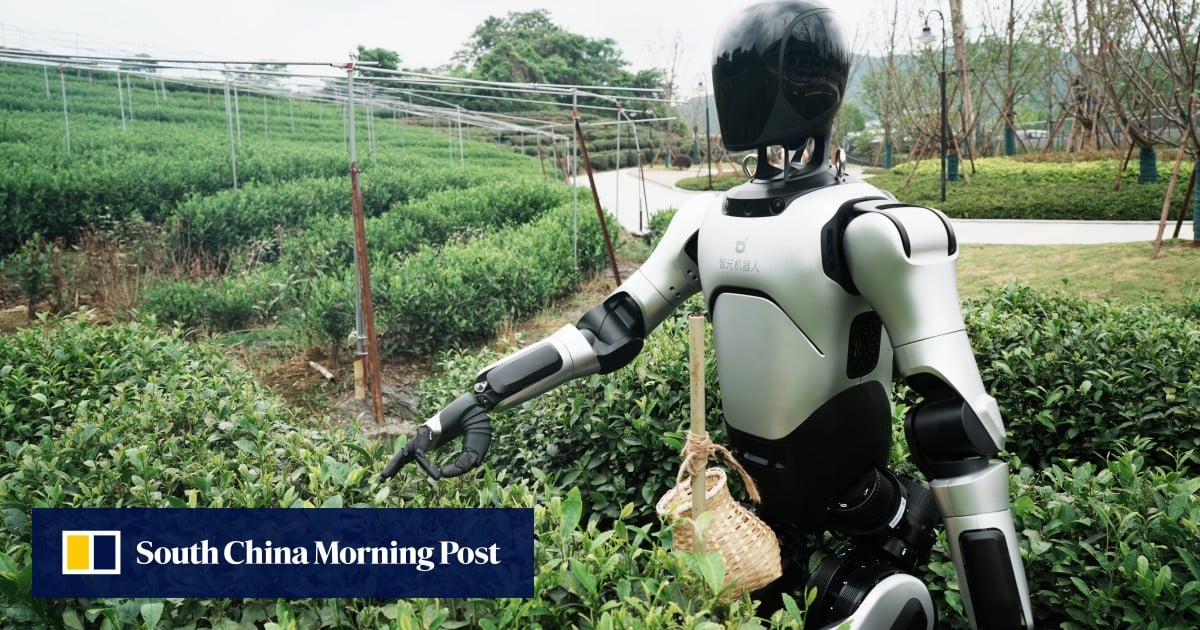
Noetra, Japan's sovereign-AI play, is a bet on homegrown 'physical AI', foundation models built to run machines. The country doesn't want to run its factories and robots on American or Chinese AI, so it's building its own AI for robots, vehicles, and factory floors. Noetra will oversee the effort, with plans to build the data center. The hardware to build it, though, still comes from Nvidia.
The U.S. chip giant is building 'a Vera Rubin AI factory', a massive data center packed with its next-generation chips, expected to launch in 2028. Noetra will oversee the effort, with plans to build the data center. The robotics coalition, on the other hand, is a group of Japan's industrial giants lining up behind Nvidia's Cosmos models. Fanuc, Yaskawa, Kawasaki Heavy, Fujitsu, Hitachi, NEC, Sony, SoftBank, Kubota, and robotics group AIRoA say they plan to build on Nvidia's Cosmos models, an open-model effort Nvidia started in May.
Toyota, which uses Nvidia chips across much of its stack, has committed its next-generation vehicles to Nvidia's Drive platform. The newer work extends Nvidia into its manufacturing, where simulations are used to design production lines, into the software that runs its vehicles, and into systems that read road traffic. Toyota's cars will run advanced driver assistance, which steers and brakes but still requires a driver.
The longer game is bigger. Japan's AI Robotics Strategy, released in March, aims to capture more than 30% of the global AI robotics market by 2040, a market Tokyo values at roughly ¥20 trillion, or about $133 billion. METI is funding a domestic foundation model to run the machines, and Noetra's Nvidia-powered factory is where models of that scale, into the trillions of parameters, would be trained.
Key points
- Nvidia's Jensen Huang visited Japan and secured deals with the country's industrial giants to build the physical-AI era.
- The projects include Noetra, a sovereign-AI play, and Toyota's cars and physical AI.
- Japan wants to own the software brain and is committing up to 1 trillion yen to back it.
- Noetra will oversee the effort, with plans to build the data center.
- The robotics coalition is a group of Japan's industrial giants lining up behind Nvidia's Cosmos models.
If this development plays out positively, Japan could become a leader in the physical-AI era, with its own software brain and a strong manufacturing base. This could lead to new opportunities for Japanese companies and create a new industry that's driven by AI.
However, there are also risks involved. Japan's dependence on American chips could be a problem, and the country's investment in physical AI might not pay off if the technology doesn't live up to expectations. Additionally, the global AI robotics market is highly competitive, and Japan might struggle to capture more than 30% of it.