Zambia: Hakainde Hichilema re-elected president with 60% of the vote despite unprecedented tensions
Zambian President Hakainde Hichilema has been re-elected for a second term with approximately 60% of the vote, amidst unusual political tensions and opposition arrests.
Intelligence analysis by Gemini 2.5 Flash
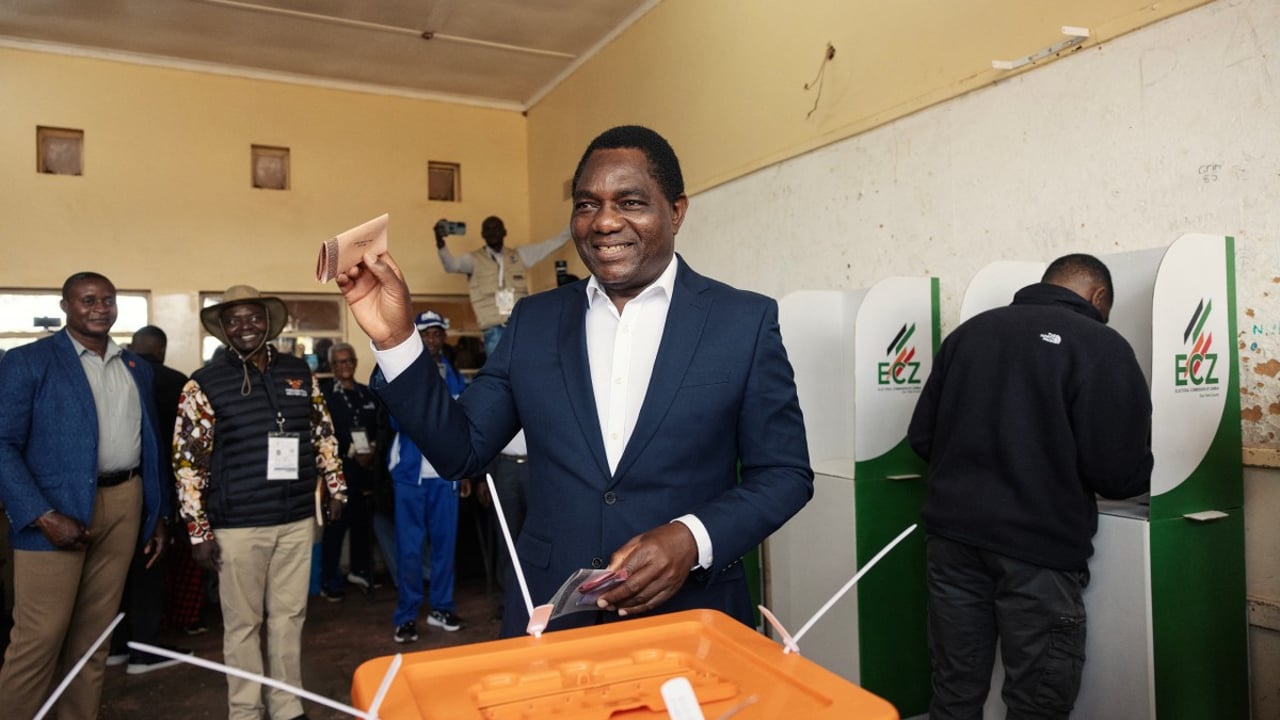
Hakainde Hichilema secured a second presidential term in Zambia, but his victory is overshadowed by claims of electoral irregularities from his main opponent, Brian Mundubile, and the arrest of several opposition figures, raising concerns among international observers about the country's democratic stability.
Imagine a big election where the current leader, Hakainde, won again with lots of votes. But some people who didn't win said there were problems, like papers being changed, and some of them even got arrested. It's like a school election where the winner is clear, but some kids feel the rules weren't fair, making everyone a bit worried even though the country usually has smooth elections.
Analysis
Hakainde Hichilema's Second Term
Zambian President Hakainde Hichilema secured a decisive victory, being re-elected for a second term with approximately 60% of the votes. The announcement by the Zambian electoral commission confirmed his win, despite five out of 226 constituencies still awaiting final tabulation, as these were deemed unlikely to alter the overall outcome significantly. Following the declaration, Hichilema, affectionately known as "HH," expressed profound gratitude for the trust placed in him by the electorate. His supporters, clad in the red colors of his United Party for National Development (UPND), poured into the streets of Lusaka, celebrating with songs, dances, and fireworks, marking a vibrant display of public jubilation.
Addressing the nation, President Hichilema extended an olive branch to those who supported his opponents, stating, "To those who preferred the ideas presented by our adversaries, we hear you, and we will continue to work for you." This gesture aimed to foster unity after a contentious electoral period. His main challenger, Brian Mundubile, a former minister under the previous administration of Edgar Lungu, garnered close to 38% of the votes, highlighting a clear mandate for Hichilema but also a significant segment of the population supporting the opposition.
Brian Mundubile's Allegations
The election was marred by significant political tensions, primarily stemming from allegations made by the main opposition candidate, Brian Mundubile. On Monday, Mundubile, 55, publicly denounced what he claimed were irregularities in the vote counting process, asserting, without providing concrete evidence, that result tabulation documents had been falsified. He argued that these alleged falsifications threatened the "integrity" of the entire counting process, casting a shadow over the legitimacy of the election results. These accusations were part of a broader pattern of disputes that characterized the campaign, the August 13 poll, and its aftermath, which were described as unusual for Zambia, a nation typically known for its stable democratic processes.
Further escalating the tensions were the arrests of 11 individuals, including six prominent opposition figures, announced by the government late on Sunday. The government justified these arrests, stating they occurred on the Thursday of the presidential and legislative elections and targeted a presumed militia. However, Mundubile's party, the NRPUP, vehemently rejected these accusations, dating the operation to Friday and denying any affiliation with a militia. The party also reported that a parliamentarian was injured by gunfire during the raid. Authorities noted that Brian Mundubile was present at the scene of the police operation, which his camp confirmed was his own residence, adding a personal dimension to the political confrontation.
Zambia's Democratic Reputation
The unprecedented tensions and controversies surrounding the election have raised considerable concerns among international observers. The electoral commission's decision to suspend vote counting for several hours due to "violence" prompted worries from bodies like the European Union. Additionally, restrictions imposed on the opposition during the campaign period were highlighted as problematic. Oxford Economics Africa, a prominent think tank, declared that "hopes for a calm and credible election in Zambia have been dashed," observing a "very tense" situation, which contrasts sharply with Zambia's historical reputation.
Zambia has long been lauded for its tradition of peaceful transfers of power through the ballot box, a practice consistently upheld since the return to multiparty democracy in 1991. This history has positioned Zambia as a beacon of democratic stability in the region. Economically, President Hichilema's first term saw a return to growth, with significant achievements cited in debt restructuring and a reduction in inflation. However, critics argue that these macroeconomic improvements have yet to translate into tangible enhancements in the living standards of ordinary citizens, suggesting a disconnect between national economic indicators and everyday realities. The challenge for Hichilema's second term will be to address these domestic concerns while navigating the political fallout from an election that has tested the country's democratic resilience.
Key points
- Hakainde Hichilema has been re-elected as Zambian President for a second term with approximately 60% of the vote.
- The election was marked by unusual political tensions, including the arrest of six prominent opposition figures.
- Main opposition candidate Brian Mundubile claimed vote falsification and irregularities, though without providing evidence.
- Election observers, including the EU and Oxford Economics Africa, expressed concerns over the process and restrictions on the opposition.
- Despite Zambia's history of peaceful power transfers, the recent events have raised worries about the country's democratic stability.
Hichilema's re-election could allow him to continue his economic reforms, such as debt restructuring and inflation reduction, potentially leading to further economic growth and stability for Zambia. His stated commitment to working for those who voted against him suggests a potential for national unity and inclusive governance.
The unprecedented tensions, opposition arrests, and claims of electoral irregularities could undermine public trust in democratic institutions and potentially lead to increased political instability or social unrest in Zambia. The concerns raised by international observers highlight risks to the country's democratic reputation and future governance.