Alibaba scales AI compute with new chip and 20 GW data center target
Alibaba is significantly expanding its AI infrastructure, unveiling the new Zhenwu V900 accelerator chip and targeting over 20 gigawatts of global data center capacity by 2032. This move aims to control more of its computing stack and support its growing AI cloud services…
Intelligence analysis by Gemini 2.5 Flash
Alibaba is making substantial investments in its AI capabilities, developing proprietary chips like the Zhenwu V900 to power its next-generation supernodes and planning a massive expansion of its data center footprint. This strategy is driven by surging demand for AI cloud services and the need to support increasingly complex AI models and agentic workloads, despite the significant ca…
Imagine Alibaba is building a giant brain for computers, like a super-smart robot. To make it super smart, they need special computer chips that work really fast, so they're making their own new chip called the Zhenwu V900. They also need huge buildings full of computers, called data centers, and they plan to build so many that they could power a small city! All this is to help their smart computer programs, like the Qwen models, learn and do amazing things, especially helping people write computer code.
Analysis
Alibaba is embarking on an aggressive expansion of its artificial intelligence infrastructure, signaling a strategic pivot towards greater control over its core computing stack. This initiative is underpinned by both hardware innovation and a massive scale-up of its data center capabilities, reflecting the escalating demands of the AI era.
Zhenwu V900
Alibaba's chip unit, T-Head Semiconductor, is set to commercially release the Zhenwu V900 accelerator in the first quarter of 2027. This proprietary chip is touted to deliver three times the performance of its predecessor, the M890, boasting 216 gigabytes of memory and an inter-chip bandwidth of 1,200 gigabytes per second. The V900 is designed to be a cornerstone of Alibaba's next-generation Panjiu supernodes, integrating with other in-house components like the XuanTie C930 server CPU and Zhenwu ICN 2.0 interconnect chip. This integrated architecture is projected to scale into clusters containing up to 500,000 accelerator cards, providing immense computing power.
The development of the Zhenwu V900 extends Alibaba's strategy to reduce reliance on external chip suppliers, a move that CEO Eddie Wu has linked to improving cloud gross margins over time. By developing more of its own hardware, Alibaba aims to gain greater control over its infrastructure and costs, even as its broader infrastructure buildout continues to consume substantial capital. This internal development roadmap also includes two new Yitian processors, the Yitian 720 for cloud computing and AI inference, and the higher-performance Yitian 730 for demanding workloads like high-performance computing and data analytics, both slated for 2027.
20 GW
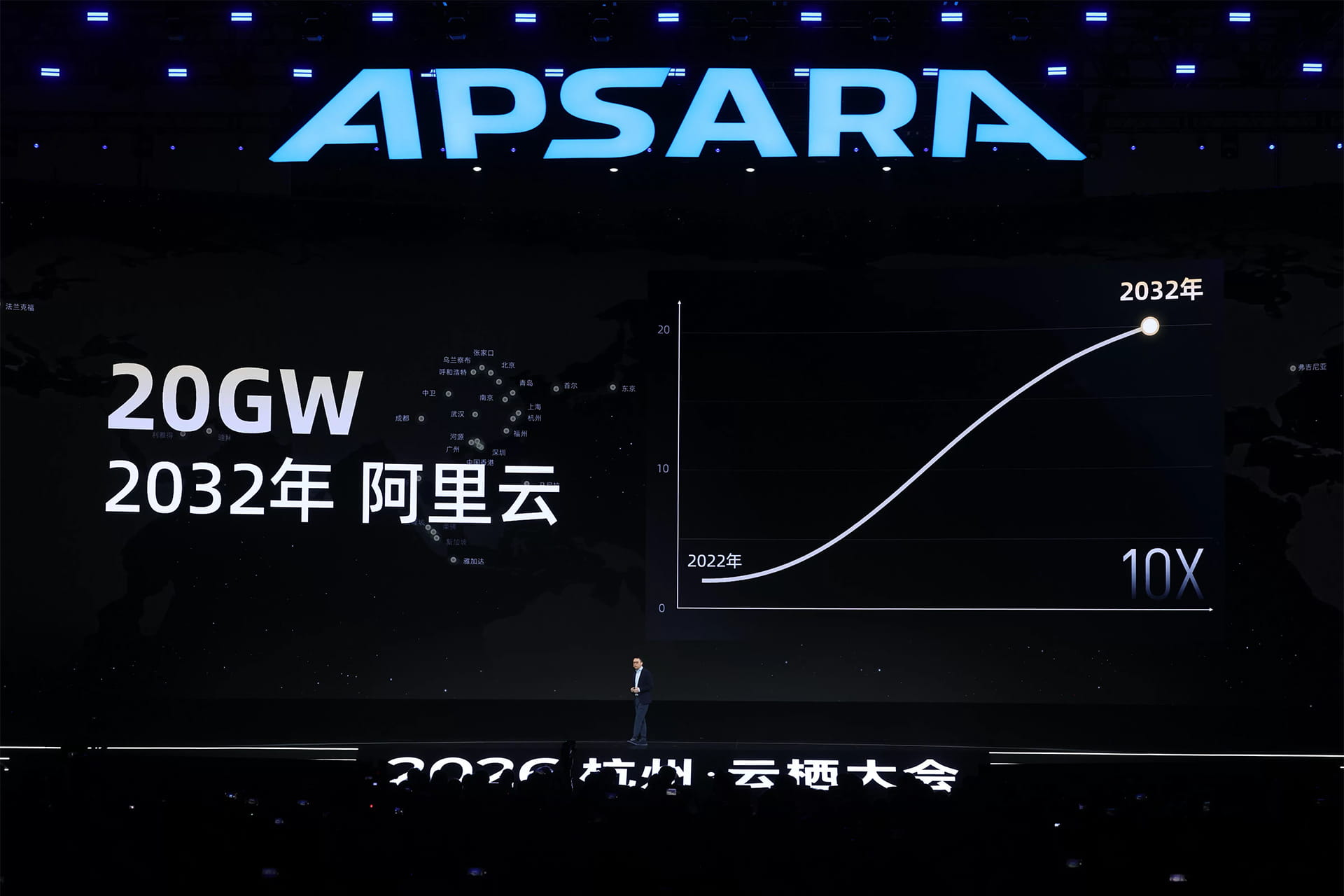
Central to Alibaba's infrastructure ambitions is its target to exceed 20 gigawatts (GW) of global data center capacity by 2032. This monumental expansion is intended to support what the company describes as an "agentic cloud," a comprehensive ecosystem spanning computing infrastructure, foundation models, and AI agents. The scale of this investment underscores the company's long-term vision for AI and its commitment to providing the foundational compute necessary for future AI applications.
This substantial increase in planned capacity comes amidst a period of significant capital expenditure for Alibaba. In the June quarter, the company spent RMB 67.7 billion (USD 10.1 billion) on capital expenditures, a 75% year-on-year increase, partly attributed to investments in AI infrastructure and higher chip component prices. This spending has, however, weighed on group-level cash generation, resulting in negative free cash flow of RMB 44.7 billion (USD 6.7 billion) in the same quarter. Despite the capital intensity, the company's AI cloud and compute services revenue grew by 44.9% year-on-year, indicating strong demand for these services.
Qwen models
Parallel to its hardware and data center expansion, Alibaba is also scaling its Qwen large language models. The company announced that Qwen 4 is currently in training, with subsequent models, Qwen 4.5 and Qwen 5, expected to scale to between five and ten trillion parameters. This continuous advancement in model complexity directly correlates with the escalating demand for computing resources, necessitating the infrastructure investments being made.
Beyond larger models, Alibaba's cloud business is increasingly focusing on AI agents, particularly in coding applications. These agentic workloads are a significant driver of computing demand, consuming substantially more tokens than conventional chatbot interactions. The company reported a 15-fold increase in revenue from Alibaba Cloud’s model-as-a-service token usage in the first five months of 2026, with monthly revenue reaching a nine-figure RMB sum. This commercial success in agentic workloads creates a reinforcing cycle: more capable models and agents drive increased cloud usage, which in turn requires more chips, servers, and data center capacity, justifying Alibaba's extensive internal development and infrastructure buildout.
Key points
- Alibaba is launching the Zhenwu V900 AI accelerator chip, developed by its T-Head Semiconductor unit, scheduled for commercial release in Q1 2027.
- The company aims to expand its global data center capacity to over 20 gigawatts by 2032 to support its 'agentic cloud' vision.
- Alibaba's capital expenditures increased significantly, reaching RMB 67.7 billion (USD 10.1 billion) in the June quarter, impacting free cash flow.
- Revenue from AI cloud and compute services grew 44.9% year-on-year, with AI-related product revenue showing 12 consecutive quarters of triple-digit growth.
- Alibaba is also scaling its Qwen models, with Qwen 4 in training and future models expected to reach trillions of parameters, driven by demand from AI agents, especially coding applications.
Alibaba's aggressive investment in proprietary AI chips and data center capacity could solidify its position as a leader in AI cloud services, driving significant revenue growth and potentially improving cloud gross margins over time. This self-sufficiency in hardware could also provide a strategic advantage in the competitive global AI landscape, fostering innovation within its ecosystem.
The substantial capital expenditure required for this infrastructure buildout could continue to weigh heavily on Alibaba's free cash flow and overall profitability in the short to medium term. There's also a risk that the proprietary chips might not achieve the anticipated performance or cost efficiencies, or that market demand shifts, making these massive investments less impactful than projected.