As long as US continues war, security not to return to Hormuz
Iran's Foreign Ministry Spokesman Esmaeil Baghaei stated that security will not return to the Strait of Hormuz as long as the US continues its blockade and military aggression against the Islamic Republic.
Intelligence analysis by Gemini 2.5 Flash
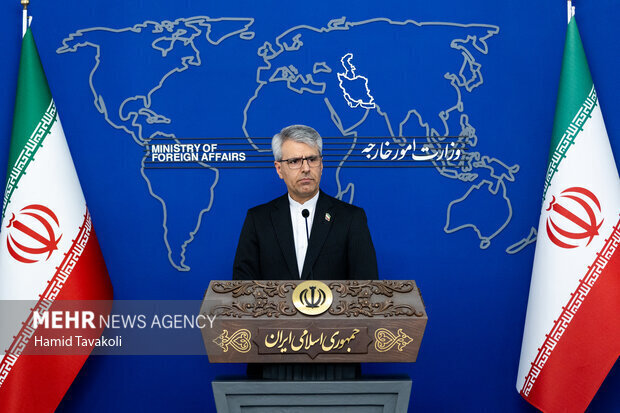
Iranian Foreign Ministry Spokesman Esmaeil Baghaei asserted that the US's ongoing 'war' and 'blockade' are preventing security in the strategic Strait of Hormuz. He criticized US Secretary of State Marco Rubio's speech as 'cognitive warfare,' highlighting Iran's millennia-long civilization and its historical contributions to Western thought, while also addressing US claims about Iran'…
Imagine the Strait of Hormuz as a very important road where many ships carry oil, like a big highway for fuel. Iran says that as long as another country, the US, keeps acting like it's fighting or blocking things there, that road won't be safe. Iran's spokesman thinks the US is trying to make Iran look bad and is ignoring how old and important Iran's history is, like trying to say a very old, wise person isn't smart. Iran also wants to help solve problems in nearby countries, like Yemen, so everyone can live peacefully.
Analysis
Iranian Foreign Ministry Spokesman Esmaeil Baghaei's recent remarks underscore a persistent and deeply entrenched point of contention between Tehran and Washington: the security of the Strait of Hormuz. Iran consistently frames its actions in the waterway as defensive responses to perceived US aggression, including blockades and military presence. This narrative is crucial for Iran's domestic audience and its regional allies, portraying the Islamic Republic as a guardian of its sovereignty against external pressures. The statement suggests that any resolution to the security concerns in the Strait is contingent upon a fundamental shift in US policy, specifically an end to what Iran terms 'war' and 'military aggression.'
Strait of Hormuz
The Strait of Hormuz is a critical chokepoint for global oil shipments, making any threat to its security a matter of international concern. Iran's assertion that security will not return as long as the US continues its actions implies a direct link between US military presence and regional instability, rather than viewing US presence as a deterrent. This perspective positions Iran as a key player whose cooperation is essential for safe passage, thereby leveraging its geographical advantage.
The spokesman's comments also challenge the American narrative regarding Iran's influence in the Strait, particularly in response to former President Trump's claims. Baghaei reframed the situation, stating that current conditions are a result of a 'direct US attack' on Iranian territory, not Iranian leverage. This rhetorical move aims to shift blame and justify Iran's defensive posture under international law, emphasizing its national sovereignty.
Marco Rubio
Baghaei's critique of US Secretary of State Marco Rubio's speech as 'cognitive warfare' reveals Iran's strategy of countering Western narratives by highlighting historical and cultural depth. By invoking the legacy of Persian poets like Hafez Shirazi and emphasizing Iran's ancient civilization, Baghaei sought to undermine the US's claim to represent Western civilization. He sarcastically suggested Rubio's advisors provide him with the Divan of Hafez to better understand Iranian culture, implying a lack of understanding on the US side.
This diplomatic tactic aims to expose what Iran perceives as hypocrisy and a distorted view of history by American officials. Baghaei argued that the West's intellectual foundations owe a debt to Iranian and Muslim thinkers, thereby challenging the notion of Western cultural superiority often implicit in US foreign policy rhetoric. This historical framing is a recurring theme in Iranian diplomacy, used to assert its legitimacy and influence on the global stage.
Yemen
The discussion extended to regional conflicts, specifically the situation in Yemen, where Iran reiterated its readiness to facilitate dialogue between Yemeni and Saudi sides. This stance aligns with Iran's broader foreign policy objective of promoting regional solutions to conflicts, often positioning itself as a mediator while simultaneously supporting allied non-state actors. The spokesman explicitly stated that continued tension in Yemen serves only the interests of the 'Zionist regime,' a common Iranian accusation aimed at delegitimizing Israeli influence and fostering regional solidarity against it.
Iran's concern for developments in the Arabian Peninsula and its call for an end to the war between 'two Islamic nations' reflects a desire to de-escalate certain regional tensions, particularly those that could be exploited by adversaries. This position, while seemingly conciliatory, is also strategic, aiming to reduce the burden of proxy conflicts and potentially open avenues for broader regional engagement, as evidenced by ongoing consultations with Saudi Arabia.
Key points
- Iran's Foreign Ministry Spokesman Esmaeil Baghaei states that security will not return to the Strait of Hormuz as long as the US continues its 'war' and 'military aggression'.
- Baghaei criticized US Secretary of State Marco Rubio's speech as 'cognitive warfare,' emphasizing Iran's ancient civilization and historical contributions.
- Iran refutes US claims about its leverage in the Strait of Hormuz, attributing current conditions to a 'direct US attack' on its territory.
- Iran reiterates its readiness to assist in dialogue between Yemeni and Saudi sides, stating that continued tension serves only the 'Zionist regime'.
- Exchange of messages through mediators regarding Iran's 'seven-day plan' and its legitimate demands, including lifting the naval blockade and releasing frozen assets, is ongoing.
The ongoing exchange of messages through mediators regarding Iran's 'seven-day plan' and consultations with regional countries like Saudi Arabia suggest potential diplomatic avenues for de-escalation. Iran's expressed readiness to assist in dialogue between Yemeni and Saudi sides could lead to a reduction in regional tensions and foster greater stability in the Arabian Peninsula.
The continued US 'blockade and military aggression,' as perceived by Iran, risks further escalating tensions in the Strait of Hormuz, potentially disrupting global oil supplies and increasing regional instability. Iran's firm stance that security will not return under current conditions suggests a prolonged standoff, with little immediate prospect of a resolution to the underlying disputes.
Market signals
- OIL Iran's statements link US actions to insecurity in the Strait of Hormuz, a vital oil transit route, implying potential supply disruptions that could push oil prices higher.
AI-generated analysis of potential market relevance. Not financial advice.