China’s ‘Tesla imitators’ have a new mission: build affordable humanoid robots for consumers
Chinese electric vehicle (EV) manufacturers, including industry giants like BYD and Nio, are expanding into humanoid robotics, viewing it as a natural extension of their carmaking capabilities.
Intelligence analysis by Gemini 2.5 Flash
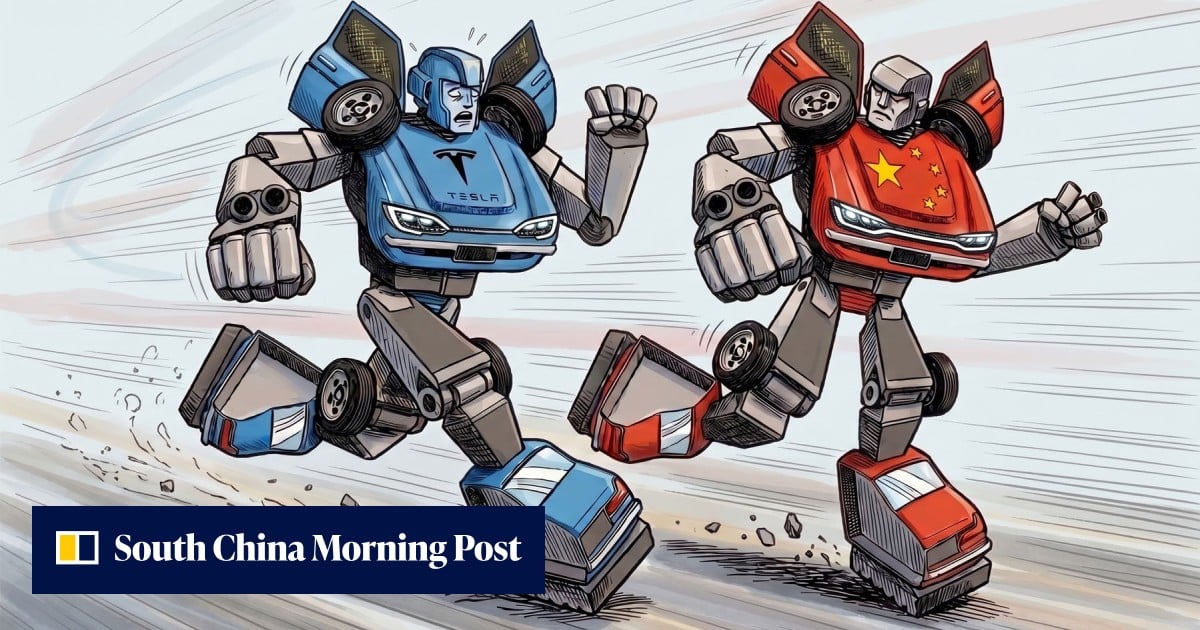
Inspired by Tesla's acceleration in commercializing its Optimus robot, over 10 Chinese intelligent vehicle makers are now pivoting to develop affordable humanoid robots for consumers. They leverage existing supply chain synergies between smart EV production and robotics, particularly in components like cameras, radar, and advanced software.
Imagine your smart electric car, which can see the road and make decisions, now has legs and arms! That's what big car companies in China are trying to build. They're using the same smart brains and parts from their cars to make robots that can help people at home, just like how Tesla is making its own robot. They hope to make these robots affordable so many families can have one.
Analysis
The convergence of automotive and robotics industries in China is gaining significant momentum, driven by the country's leading electric vehicle manufacturers. This trend is not merely an opportunistic venture but a strategic alignment based on profound technological synergies. The core idea is that the advanced perception, decision-making, and execution systems developed for smart EVs are highly transferable to humanoid robots, creating a fertile ground for innovation and cost efficiency.
Nio CEO William Li
Nio CEO William Li articulated this vision clearly, stating that robotics represents a natural extension of the company's carmaking capabilities and business acumen. He posits that future cars will essentially function as robots, equipped with sophisticated AI for perception, decision-making, and execution. While Nio has adopted a 'latecomer' strategy to mitigate early-stage investment risks, Li's conviction underscores a broader industry belief that the premium cars Nio already produces embody critical systems—perception, decision-making, and control—that are directly applicable to robotics. This perspective highlights the inherent advantage EV makers possess in entering the robotics space, leveraging their existing technological infrastructure and expertise.
Optimus
The acceleration of Tesla's humanoid robot, Optimus, into commercialization has served as a significant catalyst for Chinese EV manufacturers. This move by the American EV pioneer has prompted over 10 Chinese intelligent vehicle makers to embark on their own missions to build affordable humanoid robots for consumers. The 'Tesla imitators' label, previously applied to these companies in the EV sector, is now being repurposed for their foray into robotics, indicating a competitive drive to match or surpass global leaders. Tesla's aggressive push into robotics validates the market potential and technological feasibility, encouraging Chinese firms to commit substantial resources to this new frontier.
BYD
Among the prominent Chinese players venturing into robotics is BYD, the world's largest electric vehicle maker, alongside others like Stellantis-backed Leapmotor. The involvement of such industry titans underscores the scale and seriousness of this strategic shift. The article highlights that robotics shares significant supply chain synergy with smart EV production. Key components such as cameras and radar, along with sophisticated software, are common to both intelligent vehicles and humanoid robots. This shared technological foundation allows EV manufacturers to leverage their existing supply chains, R&D investments, and manufacturing expertise, potentially reducing development costs and accelerating time-to-market for consumer-grade humanoid robots. This integrated approach could give Chinese companies a competitive edge in bringing advanced robotics to a mass market.
Key points
- Chinese EV manufacturers are expanding into humanoid robotics, seeing it as a natural extension of their carmaking capabilities.
- Over 10 intelligent vehicle makers, including BYD and Nio, are now focused on building affordable humanoid robots for consumers.
- The move is significantly influenced by Tesla's accelerated commercialization of its Optimus humanoid robot.
- Robotics development benefits from supply chain synergies with smart EV production, utilizing shared components like cameras, radar, and software.
- Nio CEO William Li views future cars as robots, emphasizing the shared perception, decision-making, and execution systems based on AI.
This strategic expansion could lead to rapid advancements in consumer-grade humanoid robotics, making sophisticated AI-powered assistants more accessible and affordable. Leveraging existing EV supply chains and R&D could accelerate innovation, creating new industries and job opportunities within China's tech sector.
The venture into humanoid robotics is fraught with high risks and significant investment, as Nio's CEO acknowledged regarding early-stage losses. Intense competition with established players like Tesla, coupled with the complexities of developing truly affordable and functional consumer robots, could lead to substantial financial setbacks for these companies.