Japan aims for Mars' moons to unlock clues to origins of the Solar System
Japan's MMX mission is set to launch to Mars' moons, Phobos and Deimos, to collect samples that could reveal the origins of the Solar System and life on Earth. The unmanned spacecraft will also lay groundwork for future human exploration of the red planet.
Intelligence analysis by Gemini 2.5 Flash
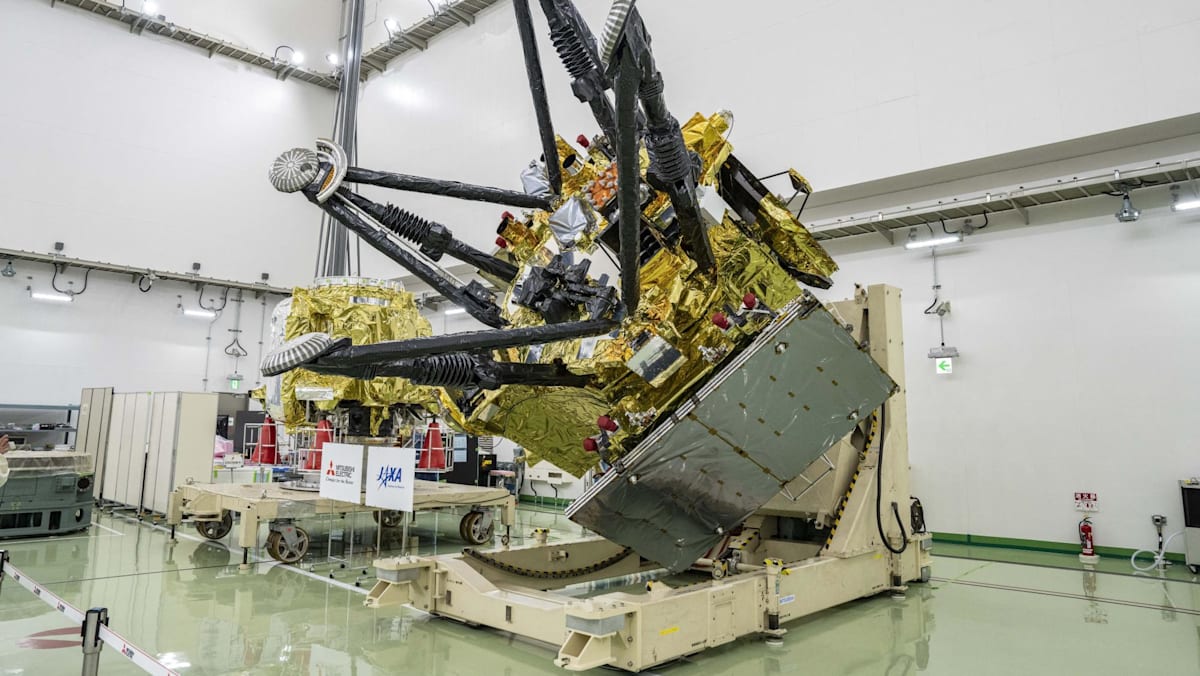
Japan's Martian Moons eXploration (MMX) mission is preparing to blast off from Tanegashima Space Center, targeting Phobos to collect at least 10g of surface material. Scientists hope the mission will resolve theories about the moons' formation and shed light on how water, volatiles, and organic compounds were delivered to inner rocky planets, potentially offering clues about the emerg…
Japan is sending a robot spaceship to Mars' tiny moons to pick up some rocks. Scientists think these rocks might be like ancient puzzle pieces that can tell us how our whole solar system, including Earth and maybe even life, first started. It's like trying to find clues in old toys to understand how your toy box was made!
Analysis
Japan's upcoming Martian Moons eXploration (MMX) mission represents a pivotal moment in humanity's quest to understand the cosmos and our place within it. Slated for launch from the Tanegashima Space Center, this unmanned endeavor is designed to retrieve samples from Phobos, one of Mars' two moons, with the ambitious goal of unraveling the mysteries surrounding the Solar System's genesis and the conditions that led to life on Earth. The mission's scientific objectives are deeply intertwined with fundamental questions about planetary formation and the transport of essential elements across vast cosmic distances. By collecting and analyzing material from Phobos, scientists anticipate gaining unprecedented insights into the early history of our planetary neighborhood.
MMX
The Martian Moons eXploration (MMX) mission is a complex undertaking, involving a spacecraft that will spend approximately three years in Mars' orbit. Its primary task is to land on Phobos and collect a minimum of 10 grams of surface material, a feat made challenging by the moon's extremely low gravity. In addition to sample collection, the mission includes the IDEFIX rover, a collaborative effort with French astrophysicists, which will conduct detailed surface observations. The spacecraft will also observe Deimos, Mars' other moon, though without a landing, before its return capsule embarks on a journey back to Earth, aiming for a landing in Australia around 2031. This multi-faceted approach ensures a comprehensive study of both Martian moons, providing a broader context for the collected samples.
Phobos
The study of Phobos is central to resolving a long-standing debate among planetary scientists regarding the origin of Mars' moons. Two prominent theories, the "giant impact" hypothesis and the "capture" hypothesis, offer contrasting explanations. The former suggests that the moons formed from debris ejected after a celestial body collided with Mars, similar to the Earth-Moon system's formation. Conversely, the "capture" hypothesis posits that Phobos and Deimos are asteroids from the outer Solar System that were gravitationally snared by Mars. Determining which theory is correct is crucial for understanding the early dynamics of the Solar System and the mechanisms that delivered water, volatiles, and organic compounds to the inner rocky planets. These materials are considered key ingredients for the emergence of life, making Phobos a potential repository of clues to life's origins.
IDEFIX
The IDEFIX rover, named after Asterix's dog, is a critical component of the MMX mission, designed to perform surface observations on Phobos. This international collaboration, involving Japan Aerospace Exploration Agency (JAXA), France's National Centre for Space Studies (CNES), the German Aerospace Center (DLR), NASA, and the European Space Agency (ESA), underscores the global nature of space exploration. The development of the spacecraft's landing legs, in particular, presented significant engineering hurdles due to Phobos's minimal gravitational pull, requiring innovative solutions to prevent the probe from bouncing off the surface. Beyond its scientific objectives, the MMX mission also aims to establish the technological capabilities required for a round trip to Mars, exploring the possibility of utilizing Phobos as a "natural space station." This aspect of the mission is deemed essential for paving the way for future crewed Mars exploration, marking a significant step towards human interplanetary travel.
Key points
- Japan's MMX mission aims to collect samples from Mars' moon Phobos to study the Solar System's origins.
- The mission will orbit Mars for three years, land on Phobos with the IDEFIX rover, and observe Deimos.
- Samples are expected to return to Earth in Australia around 2031.
- Scientists hope to determine if Martian moons formed from an impact or were captured asteroids, shedding light on life's origins.
- MMX is an international collaboration involving JAXA, CNES, DLR, NASA, and ESA.
If successful, the MMX mission could provide unprecedented insights into the formation of the Solar System and the conditions necessary for life, significantly advancing astrobiology and planetary science. The mission's technological achievements could also pave the way for future human exploration of Mars, establishing crucial round-trip capabilities.
The mission faces significant technical challenges, particularly with landing on Phobos's extremely low gravity and ensuring the safe return of samples, which could lead to failure or incomplete data collection. A rival Chinese mission also aims to return samples first, potentially diminishing the unique impact of Japan's findings if delayed.