Trump criticism leads to rare criminal charges for Air Force officer who called for impeachment
A US Air Force officer, Maj. Jason Watson, was arrested twice for calling for the impeachment of President Donald Trump. He faces rare criminal charges under the Uniform Code of Military Justice for his comments.
Intelligence analysis by Llama
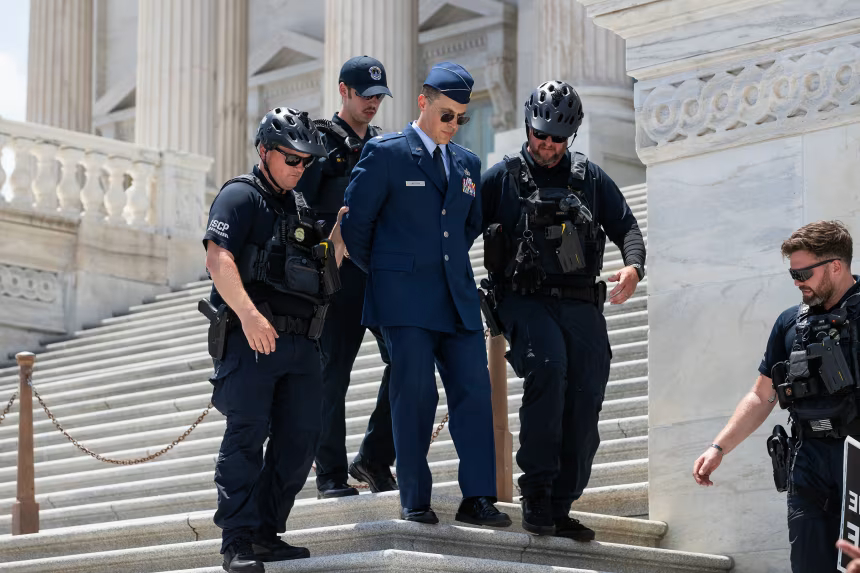
A US Air Force officer, Maj. Jason Watson, was arrested twice for calling for the impeachment of President Donald Trump. He faces rare criminal charges under the Uniform Code of Military Justice for his comments. Watson's case is a rare instance of a military officer being charged with contempt of officials for criticizing the president.
A US Air Force officer, Maj. Jason Watson, was arrested twice for calling for the impeachment of President Donald Trump. He faces rare criminal charges under the Uniform Code of Military Justice for his comments. This is a rare instance of a military officer being charged with contempt of officials for criticizing the president.
Analysis
Article 88 Charges: A Rare Instance of Contempt of Officials
Maj. Jason Watson, a US Air Force officer, has been charged with rare criminal charges under the Uniform Code of Military Justice for his comments criticizing President Donald Trump. The charges, which include three violations of Article 88 for alleged 'contemptuous' remarks about Trump, five violations of Article 92 for allegedly disobeying orders, and two violations of Article 133 for alleged conduct unbecoming an officer, are a rare instance of a military officer being charged with contempt of officials for criticizing the president.
Watson's case is a significant development in the ongoing debate about the limits of free speech in the military. The Uniform Code of Military Justice prohibits military personnel from participating in uniform in any overtly partisan activity, such as a political protest, or using 'contemptuous words' against the president and other high-ranking civilian officials. While many low-level offenses of these rules are resolved informally, Watson's violations were unusually high-profile.
A History of Rare Convictions
The rare Article 88 charges against Watson are connected to his June interview with the Defenders of our Republic Substack newsletter, his July 1 protest in uniform at the US Capitol, and an August 17 CNN interview. Military courts-martial leading to 'contempt of officials' charges are rare - a CNN review only identified two such convictions that have occurred since the modern Uniform Code of Military Justice was enacted in 1951. In 1965, an Army lieutenant was convicted of the charge after he participated in an off-base protest against the Vietnam War in El Paso, Texas. Lt. Henry Howe was sentenced to a dismissal from the service - the equivalent of a dishonorable discharge for an officer - and a year in the military prison at Fort Leavenworth, Kansas.
Implications for Free Speech in the Military
Watson's case raises questions about the limits of free speech in the military. The Uniform Code of Military Justice prohibits military personnel from participating in uniform in any overtly partisan activity, such as a political protest, or using 'contemptuous words' against the president and other high-ranking civilian officials. However, the standard for 'contemptuous' words is 'less than precise' in guidance provided to military judges and panel members. It remains to be seen whether Watson's case will be referred to trial, and whether that trial will be considered a special or general court-martial.
Key points
- Maj. Jason Watson, a US Air Force officer, was arrested twice for calling for the impeachment of President Donald Trump.
- Watson faces rare criminal charges under the Uniform Code of Military Justice for his comments.
- The charges include three violations of Article 88 for alleged 'contemptuous' remarks about Trump, five violations of Article 92 for allegedly disobeying orders, and two violations of Article 133 for alleged conduct unbecoming an officer.
- Watson's case is a rare instance of a military officer being charged with contempt of officials for criticizing the president.
- The Uniform Code of Military Justice prohibits military personnel from participating in uniform in any overtly partisan activity, such as a political protest, or using 'contemptuous words' against the president and other high-ranking civilian officials.
If Watson's case is resolved in a way that upholds the principles of free speech, it could set a positive precedent for military personnel to express their opinions without fear of reprisal. This could lead to a more open and honest dialogue within the military.
If Watson's case is resolved in a way that restricts free speech, it could have a chilling effect on military personnel who want to express their opinions. This could lead to a more restrictive and less open environment within the military.